


JurnalPost.com -- A bunch of water spinach (kangkung) at Pasar Modern Bintaro Jaya, South Tangerang, is priced between IDR 5,000 and IDR 8,000, while a kilogram of curly chilies costs IDR 60,000 or more. This significant price gap does not stop shoppers from buying. Interviews conducted by our team with various market vendors reveal that price is only one of many factors determining the types and quantities of food items purchased by the public.
Prices Rise, Purchases Shrink, But Shopping Continues
In economic theory, the law of demand states that price increases tend to reduce the quantity demanded. The magnitude of this change in demand due to price fluctuations can be measured through price elasticity of demand (Mankiw, 2020).
The vendors we interviewed confirmed this trend across five studied commodities: water spinach, tomatoes, chilies, eggplant, and carrots.
When the price of eggplant rose from IDR 10,000 to IDR 18,000 per kilogram, customers who usually bought a full kilogram reduced their purchase to half a kilogram. A similar behavior was observed with carrots; when prices increased from IDR 23,000 to IDR 28,000 per kilogram, purchase volumes dropped from half a kilogram to a quarter (Group 1, 2026a).
For chilies, price hikes did not immediately stop purchases but rather altered the quantity bought. Consumers still visit the market, adjusting their shopping amounts according to their financial capacity.
Vendors also noted that some buyers prefer shopping at the market over mobile vendors when prices rise. Chilies are a staple cooking ingredient used daily, making them relatively difficult to remove entirely from household shopping lists.
Cheap Greens, Expensive Chilies
Differences in consumer behavior can be observed by comparing spending on each commodity relative to household income.
A shopper with a monthly income of approximately IDR 3 million buys two bunches of water spinach weekly, spending about IDR 40,000 per month. This expenditure accounts for less than 1.5 percent of their monthly income.
Meanwhile, another shopper earning IDR 3.5 million per month buys about 1.5 kilograms of chilies weekly, with reported spending of around IDR 270,000 per month, or nearly 8 percent of their income.
For carrots, consumer spending was recorded at approximately IDR 92,000 per month, or about 3 percent of income (Group 1, 2026a).

Because the price of water spinach is relatively affordable, small price changes tend not to significantly affect purchasing decisions. This aligns with vendor reports that demand for water spinach remains relatively stable.
National consumption data also ranks water spinach as one of the most consumed vegetables in Indonesian households (Center for Agricultural Data and Information Systems, 2024).
Interestingly, vendors classify these five commodities as goods with inelastic demand—a condition where the percentage change in quantity demanded is smaller than the percentage change in price.
However, simple calculations based on our interview results show a more diverse picture.
For eggplant, the price increased by 80 percent, while the purchase quantity decreased by 50 percent. Using a simple elasticity approach with the initial value as the basis, the elasticity is approximately 0.63, indicating inelastic demand.
Conversely, for carrots, the price increased by about 22 percent, but the purchase quantity dropped by 50 percent. This calculation yields an elasticity of approximately 2.3, indicating elastic demand.
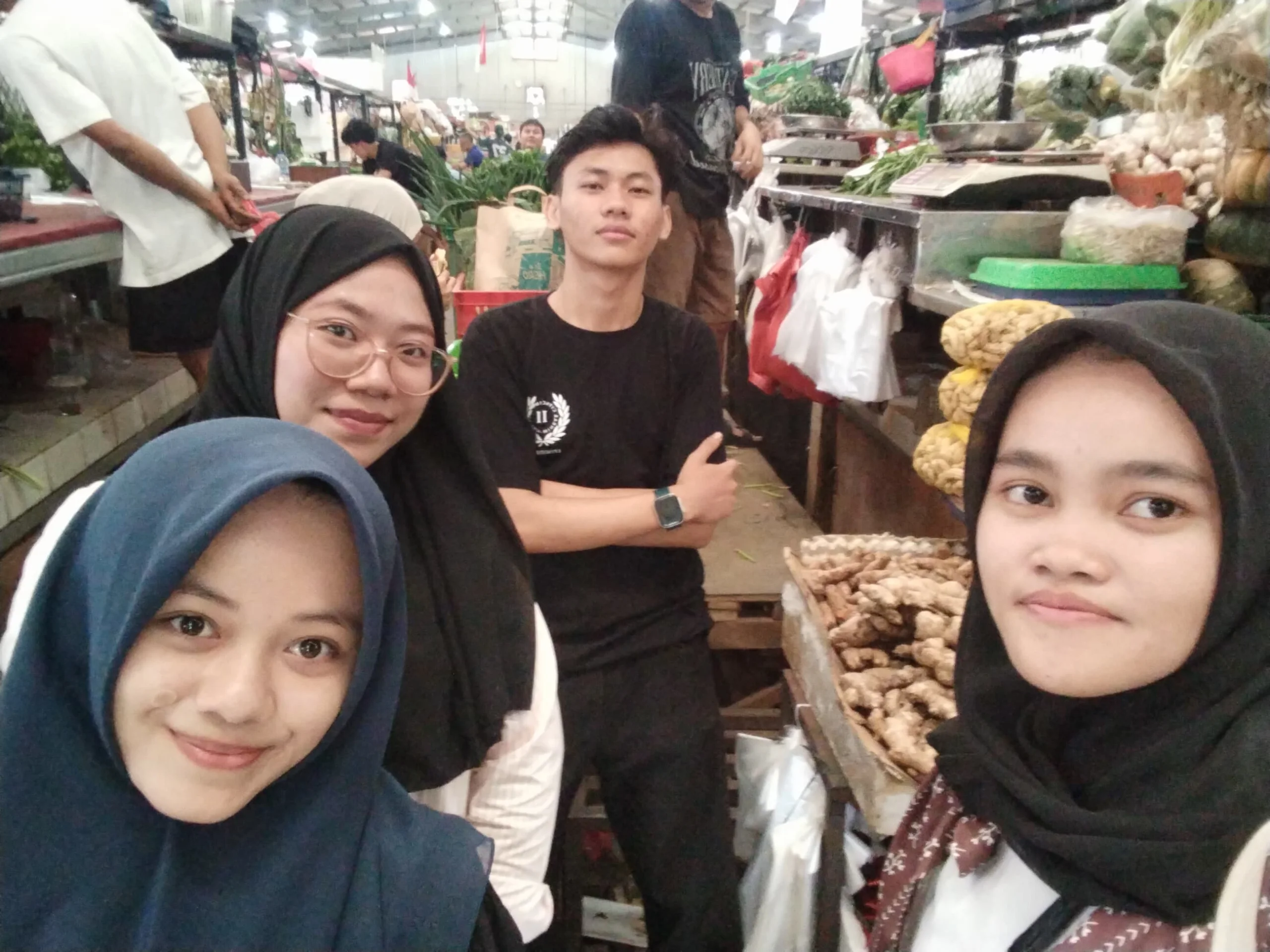
These results show that not all vegetables share the same demand characteristics. Some commodities are consistently purchased despite price hikes, while others are more easily reduced or substituted.
Nevertheless, these calculations are based on a limited sample and cannot be generalized to all consumers. Research with a larger number of respondents is needed to obtain a more representative picture of demand elasticity.
It Is Not Just About Price
Consumer decisions to buy vegetables are not influenced by price alone. Several other factors determine public consumption patterns.
First, the availability of substitute goods. Water spinach buyers may switch to spinach if the quality of the water spinach is not fresh. Eggplant consumers might choose cucumbers, while tomato buyers sometimes replace them with lime for specific cooking needs.
The existence of substitutes allows consumers to adjust spending without having to completely reduce food consumption.
Second, the relationship between complementary goods. Water spinach is often cooked with shrimp paste (terasi), carrots are combined with potatoes for vegetable soup, eggplant is processed with chilies into balado, and tomatoes are generally bought alongside chilies and shallots.
This interconnected purchasing pattern aligns with market basket analysis studies on vegetable purchases (Arianto & Nugroho, 2022).
For vendors, this relationship has important implications. When chili prices rise sharply, a consumer's decision to buy complementary ingredients like tomatoes and eggplant may also change.
Third, the number of family members and consumption needs. A household with seven members tends to require more water spinach compared to a family of three that only buys half a kilogram of tomatoes per week.
Consumption needs can also increase during family events or business activities, such as food stalls. In such conditions, vegetable purchases can reach several kilograms at once.
Fourth, consumer tastes and preferences. Carrot buyers at Pasar Modern Bintaro Jaya tend to prefer large carrots for soups and capcay. Meanwhile, eggplant buyers consider the variety, size, and freshness before making a choice.
Previous research on consumer preferences at Pasar Modern Bintaro shows that purchasing decisions involve an evaluation process of various product alternatives (Nugraha et al., 2023).
Thus, quality, freshness, size, and suitability for cooking needs are considerations just as important as price.
Price, Bargaining, and Supply Chains
Vegetable prices at Pasar Modern Bintaro Jaya are not always fixed. The bargaining process remains part of the interaction between vendors and buyers, especially for bulk purchases.
Chili vendors, for example, offer a discount of about IDR 5,000 per kilogram for purchases of at least one kilogram. The price, initially IDR 60,000, can be reduced to IDR 55,000 per kilogram.
For carrots, the price of IDR 23,000 per kilogram can drop to IDR 21,000 after bargaining. Meanwhile, the price of eggplant can be reduced by about IDR 1,000–IDR 2,000 per kilogram.
Bulk purchases generally provide opportunities for consumers to obtain lower prices (Group 1, 2026a).
Regarding supply, there is an interesting condition to note. The water spinach sold at the market comes from suppliers in Bogor, even though our literature review shows that Pondok Aren District, where the market is located, has significant potential for water spinach production.
Based on data collected by the group, the selling price of water spinach from farmers to middlemen is reported to range from IDR 800 to IDR 1,000 per bunch. Meanwhile, the selling price at the market can reach IDR 5,000 or more per bunch (Group 1, 2026b).
This price difference illustrates the marketing margin between the farmer level and the final consumer. However, this margin cannot be directly considered the vendor's net profit because it still includes costs for transportation, distribution, storage, shrinkage, and the risk of product damage.
For other commodities, carrots are supplied from Cianjur and Bandung, while tomatoes and chilies are brought in from various supplier regions.
Interview results also show that the weekly inventory or sales volume reported by vendors includes approximately 84 bunches of water spinach, 56 kilograms of tomatoes, 161 kilograms of chilies, 21 kilograms of eggplant, and 14 kilograms of carrots (Group 1, 2026a).
This data provides an overview of the scale of trade for the observed commodities. However, additional information regarding storage capacity, delivery frequency, and inventory turnover rates is needed to assess stock adequacy more accurately.
Long distribution chains and dependence on supplier regions can increase the risk of price changes when production, transportation, or distribution disruptions occur.
What Needs to Be Done?
Based on observations and analysis, there are three practical lessons that deserve the attention of vendors, market management, and local government.
First, vendors need to understand the demand characteristics of each commodity. For water spinach and chilies, which are consistently needed by consumers, maintaining product availability and freshness is a crucial step to retaining customers.
Meanwhile, for commodities like carrots and eggplant, pricing needs to consider consumer sensitivity to price changes so that sales volume does not experience too significant a decline.
Second, vendors can develop package sales strategies. For example, a balado ingredient package consisting of chilies, tomatoes, and eggplant, or a vegetable soup package containing carrots, potatoes, and other complementary ingredients.
This strategy can leverage the habits of consumers who buy several types of vegetables simultaneously. In addition to providing convenience, cooking ingredient packages also have the potential to increase the value of sales transactions.
Third, local government and market management need to encourage supply chain efficiency. One step that can be taken is to strengthen relationships between local farmers, farmer groups, distributors, and market vendors.
With a more efficient distribution chain, marketing costs can potentially be reduced, prices at the consumer level can become more competitive, and farmers have the opportunity to obtain better selling prices.
However, these efforts still need to consider local production capacity, supply sustainability, product quality, and market needs.
Ultimately, vegetable shopping activities at Pasar Modern Bintaro Jaya show that consumption decisions are the result of complex economic considerations. Price is indeed an important factor, but tastes, income, number of family members, availability of substitutes, cooking needs, and trust-based relationships with vendors also influence purchasing decisions.
Understanding these patterns can help vendors develop more precise sales strategies while providing input for the government in formulating food policies that meet the needs of the community.
Bibliography
Arianto, S., & Nugroho, A. J. (2022). Association Rule-Market Basket Analysis (AR-MBA) for analyzing vegetable purchasing decisions. Jurnal Cakrawala Ilmiah, 1(10), 2637–2648. https://doi.org/10.53625/jcijurnalcakrawalailmiah.v1i10.2595
Group 1. (2026a). Field data analysis of demand for water spinach, tomatoes, chilies, eggplant, and carrots at Pasar Modern Bintaro Jaya [Primary data: vendor and buyer interviews, unpublished].
Group 1. (2026b). Analysis of strategic issues regarding commodity demand at Pasar Modern Bintaro Jaya [Group assignment report, unpublished].
Mankiw, N. G. (2020). Principles of economics (9th ed.). Cengage Learning.
Nugraha, M. G., Utami, A. D., & Herawati. (2023). Analysis of consumer preferences and purchasing decisions for beef at Pasar Modern Bintaro [Undergraduate thesis, IPB University]. IPB Scientific Repository. http://repository.ipb.ac.id/handle/123456789/124264
Center for Agricultural Data and Information Systems. (2024). Food consumption statistics for 2024. Ministry of Agriculture of the Republic of Indonesia. https://satudata.pertanian.go.id/details/publikasi/781



Comments 0
Write a Comment Share your response