

Abstract
Declining water quality due to microbiological contamination and high turbidity requires effective and practical water treatment methods. This study aims to develop AquaClarify granules, which combine alum as a coagulant, activated carbon as an adsorbent, and sodium hypochlorite as a disinfecting agent in a single formulation.
The granules were produced using a wet granulation method with the addition of starch and polyvinylpyrrolidone (PVP) as excipients. Microbiological performance was evaluated using the Most Probable Number (MPN) five-tube series method based on APHA 9221 procedures.
Based on wastewater sample testing, the MPN index before treatment was 23 MPN/100 mL, while after treatment with AquaClarify granules, the result was less than 2 MPN/100 mL.
These results indicate a decrease in the MPN index following treatment, though they do not prove that the sample is entirely free of bacteria or that the contribution of each individual ingredient can be determined separately.
The available data are also insufficient to establish an optimum dosage or to confirm the effectiveness of the granules regarding turbidity and other water quality parameters.
Therefore, further testing with varied dosages, repetitions, and measurements of physical and chemical parameters is required to thoroughly evaluate the performance and safety of AquaClarify.
Keywords: AquaClarify, wet granulation, coagulation, activated carbon, sodium hypochlorite, MPN.
Introduction
Water quality is a critical factor affecting public health. Water contaminated by pathogenic microorganisms, particularly Escherichia coli (E. coli) and total coliforms, can serve as an indicator of microbiological contamination that potentially causes various diseases, such as diarrhea, typhoid, and cholera (Hastiaty et al., 2023).
This issue requires increased attention because the presence of antibiotic-resistant bacteria can heighten health risks if contamination is not properly managed.
Research in Indonesia indicates that E. coli has been found to possess resistance to several types of antibiotics, making the control of microbiological contamination in water a vital aspect of public health preservation (Putu et al., 2024).
In addition to microbiological contamination, turbidity is also an important parameter in determining water quality.
Turbidity can be caused by suspended particles, organic material, and various other components that scatter light in water. This condition not only affects the physical appearance of the water but can also inhibit the effectiveness of the disinfection process.
Therefore, water treatment must consider both the reduction of turbidity and the control of microorganisms to improve the resulting water quality (Wiranti et al., 2023).
Various methods have been developed to address these issues, including coagulation using alum and adsorption using activated carbon.
Alum functions by destabilizing colloidal particles so they can aggregate into flocs, making them easier to separate through sedimentation. Meanwhile, activated carbon possesses adsorption capabilities that can be utilized to reduce various impurities in water (Purba & Sembiring, 2025).
Nevertheless, water treatment that combines these mechanisms with a disinfection process in a single, practical dosage form remains an opportunity for development.
Sodium hypochlorite (NaOCl) can be used as a disinfecting agent to help control microorganisms in water, potentially complementing the functions of coagulation and adsorption (Wiranti et al., 2023).
Based on these issues, this study developed AquaClarify, a compressed granule that combines alum, activated carbon, and sodium hypochlorite as a purification medium for water contaminated with E. coli bacteria.
The combination of these three materials is designed to integrate coagulation, adsorption, and disinfection processes into a single formulation.
This study aims to evaluate the effect of varying granule dosages on the reduction of water turbidity and the count of E. coli bacteria, as well as to determine the formulation that provides the best performance.
The results are expected to serve as a foundation for developing practical and easily applicable water treatment technology, while maintaining focus on water quality parameters and the safety of the treated output.
Research Methods
Research Tools and Materials
The equipment used in this study includes an analytical balance, mortar and pestle, 60-mesh sieve, oven, beakers, measuring cylinders, pipettes, magnetic stirrer, a spectrophotometer, and supporting equipment for microbiological testing.
This equipment was used in the granule production process, water sample preparation, water quality testing, and product characteristic evaluation.
The wastewater samples used for purification testing were obtained from the Universitas Muhammadiyah Surakarta Hospital (RS UMS).
Microbiological testing was conducted on wastewater samples before and after treatment using AquaClarify granules. The identity, volume, and handling conditions of the samples were recorded to maintain the traceability of the test results.
Formulation and Production of AquaClarify Granules
AquaClarify granules were designed by combining three main ingredients: alum as a coagulant, activated carbon as an adsorbent, and sodium hypochlorite as a disinfectant.
Starch and polyvinylpyrrolidone (PVP) were used as excipients to support granule formation.
The production of AquaClarify granules was designed using a wet granulation approach.
The process began by weighing each ingredient according to the formulation composition using an analytical balance. Alum, activated carbon, and starch were then mixed until a homogeneous powder mixture was obtained.
The mixing stage aims to assist in the uniform distribution of solid components before the granulation process.
PVP was prepared as a binder using a solvent appropriate to the formulation procedure. The binder solution or mixture was added gradually to the powder mixture while stirring until a mass suitable for granulation was formed.
The wet mass was then passed through a 60-mesh sieve to produce granules with a more uniform size.
The granules then underwent a drying stage according to established procedures.
The research design specified drying in an oven at 40°C for 30 minutes, with a target moisture content of less than 5%. This condition needs to be verified against actual procedures and the compatibility of the active ingredients used.
After drying, the granules were evaluated based on their physical characteristics before being used in water purification testing.
Wastewater Sample Preparation
Wastewater samples from the Universitas Muhammadiyah Surakarta Hospital (RS UMS) were prepared for purification performance testing.
Sample volume, collection time, and storage and handling conditions need to be recorded according to actual implementation so that sample characteristics remain traceable.
Before treatment, the water samples were planned to be examined based on initial quality parameters, including turbidity, pH, and microbiological parameters.
Initial measurements serve as comparative data to evaluate changes in water quality after the addition of the granules.
All measurements must use methods appropriate to the analyzed parameters and be recorded along with their units and testing conditions.
Evaluation of Granule Physical Characteristics
The physical evaluation of the granules was designed to determine the characteristics of the product resulting from the granulation process.
Parameters listed in the research design include moisture content, particle size distribution, compressibility, and angle of repose.
These tests were used to assess the physical characteristics and flow behavior of the granules.
The moisture content test was conducted to determine the water content in the granules after the drying process. Measurement results are expressed as a percentage based on the measurement method used.
The target moisture content of less than 5% is a formulation target, not a measurement result that can be declared achieved before actual data is available.
Particle size distribution was evaluated to determine the size spread of the produced granules. This evaluation can be used to assess the uniformity of granule size based on the applied analytical method.
Meanwhile, the compressibility test was used to evaluate changes in granule volume or density due to compaction according to the chosen test procedure.
Turbidity and pH Testing
Turbidity and pH measurements were designed to evaluate changes in water characteristics before and after granule treatment.
Turbidity relates to the presence of suspended particles that can scatter light, while pH indicates the acidic or basic condition of the water sample.
In the research design, turbidity measurement was performed using a spectrophotometer at a wavelength of 800 nm, while pH was checked using indicator paper.
These measurement methods need to be supplemented with actual operational procedures, including calibration methods, the use of blanks or standards, and methods for converting measurement results into appropriate units.
If turbidity measurement results are obtained in the form of absorbance, the value cannot be directly reported as NTU without a validated calibration or correlation method.
Therefore, the result units must follow the measurement method actually used.
Turbidity and pH results before and after treatment were then compared to evaluate the changes occurring in each group.
Microbiological Testing with the MPN Method
The microbiological testing available in the laboratory report uses the Most Probable Number (MPN) five-tube series method based on APHA 9221 procedures.
Testing was conducted on samples labeled as wastewater before treatment and wastewater after treatment using the granules.
Test results were determined based on the combination of positive tubes at the testing stage recorded in the laboratory report.
This combination was then used to determine the MPN index per 100 mL according to the interpretation table of the method used.
The results before treatment serve as a comparison against the results after treatment.
Based on the available report, the wastewater sample before treatment showed a final positive tube combination of 5–0–0 with an index of 23 MPN/100 mL.
Meanwhile, the wastewater sample after granule treatment showed a final positive tube combination of 0–0–0 with an index of less than 2 MPN/100 mL.
A value of less than 2 MPN/100 mL must be interpreted as a result below the reporting limit or detection limit applicable to that method, not as proof that all microorganisms have been eliminated from the sample.
Because the source of the wastewater sample in the MPN report has not been confirmed to be identical to the river water sample in the dosage variation test, the MPN results must be reported separately until the link between the two tests can be confirmed.
AquaClarify Production Flowchart
The microbiological testing whose results are reported in this study uses the five-tube series MPN method based on APHA 9221.
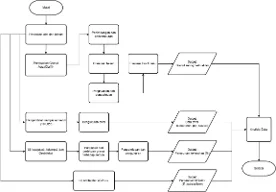
Samples before and after treatment were compared based on the positive tube combination and the MPN index per 100 mL. The methods and testing conditions listed in the article are adjusted to the available laboratory reports.
Results and Discussion
Characteristics of AquaClarify Granules
This study produced AquaClarify compressed granules that combine alum, activated carbon, and sodium hypochlorite (NaOCl) as a water purification medium.
Alum is used as a coagulant, activated carbon as an adsorbent, while sodium hypochlorite acts as a disinfecting agent.
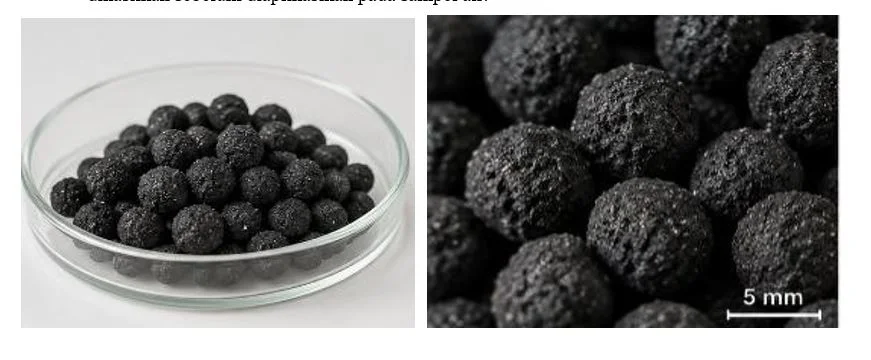
The formulation was designed to integrate the mechanisms of coagulation, adsorption, and disinfection into a single granule dosage form.
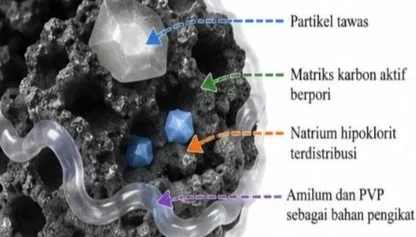
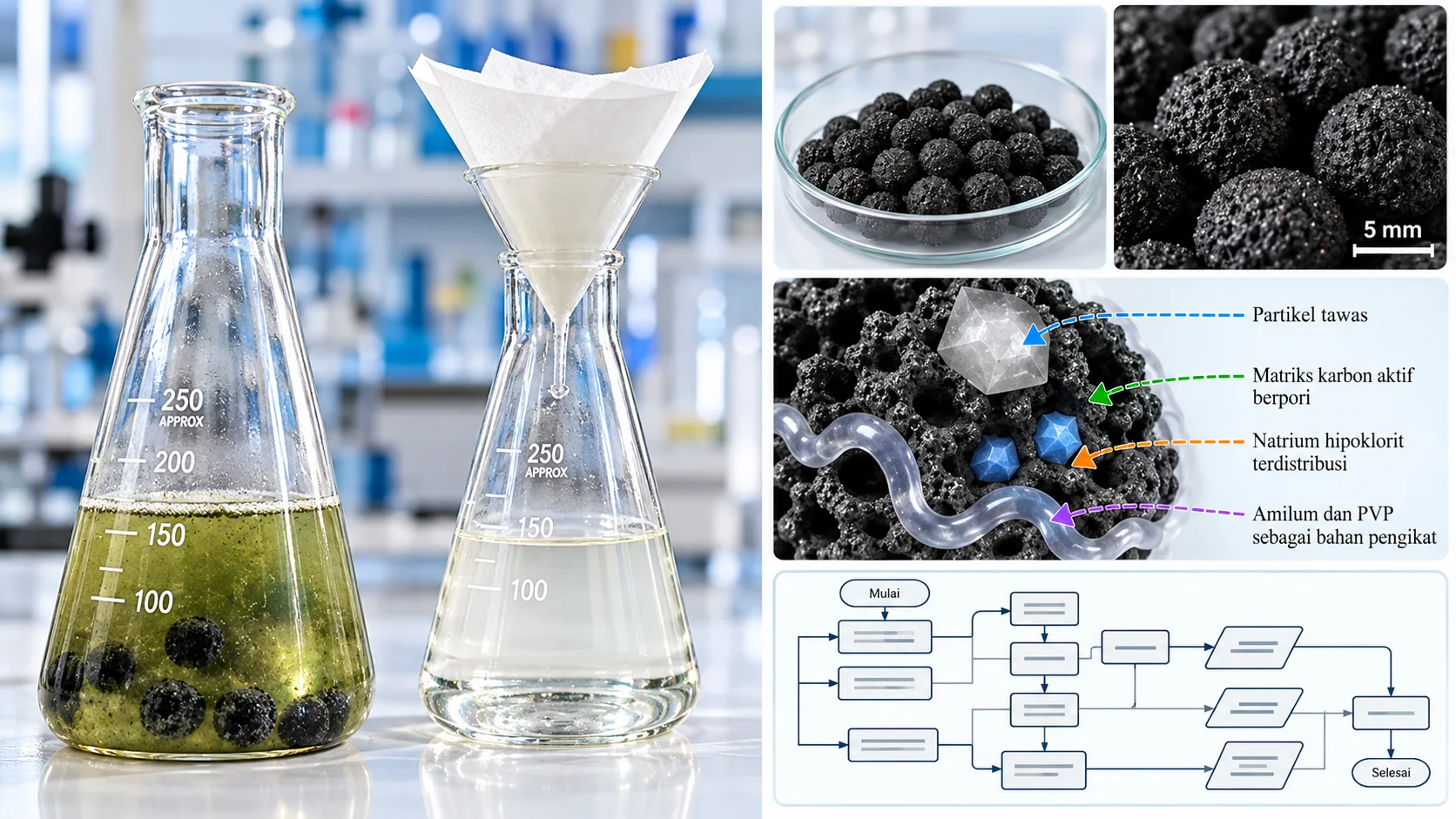
Product documentation was used to show the physical form of the granules produced before application to water samples.
Changes in Visual Water Conditions After Treatment
Initial testing was conducted to evaluate changes in water sample characteristics before and after the addition of AquaClarify granules.
Observed parameters included visual condition, degree of acidity (pH), and spectrophotometer readings at a wavelength of 800 nm.
Based on visual observation, the sample before treatment showed a cloudy condition, while the sample after treatment showed a clearer condition.
This change indicates a shift in the physical characteristics of the sample after treatment.
Theoretically, alum can assist in the destabilization of suspended particles so that flocs are formed that are easier to separate, while activated carbon has the potential to adsorb certain impurities present in the water.
Visual testing was conducted using wastewater samples obtained from the Universitas Muhammadiyah Surakarta Hospital (RS UMS).
Based on the documentation in Figure 4, the wastewater sample after the addition of AquaClarify granules before filtration showed a greenish color, while the filtrate after filtration appeared clearer.
This change indicates a difference in visual characteristics after the series of treatments and filtration.
However, the change in clarity cannot be attributed entirely to the use of the granules because the filtration process also contributes to the separation of particles from the liquid.
Therefore, quantitative turbidity measurement is required to evaluate changes in the physical quality of the sample more objectively.
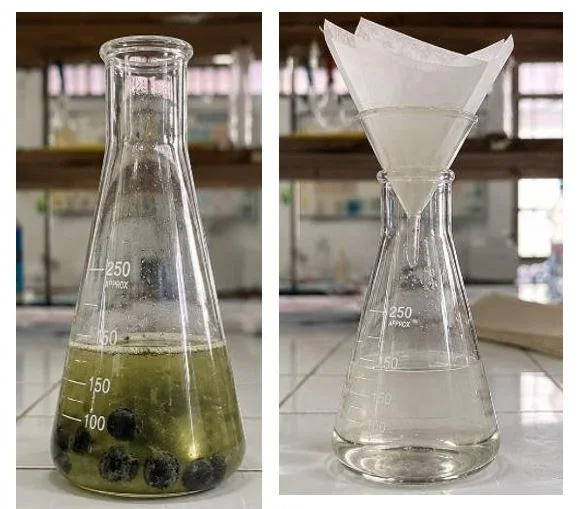
The visual difference in Figure 4 shows that the filtered liquid has a clearer appearance compared to the sample before filtration.
However, this change is the result of a series of treatments and filtration, so the influence of each process cannot be separated based solely on visual documentation.
Therefore, this observation needs to be supported by quantitative turbidity measurement to determine the magnitude of the change in the physical characteristics of the water.
pH and Spectrophotometer Measurement Results
pH measurement results show that the sample before treatment had a pH of 8, while after the addition of the granules, the pH value decreased to 6.
This decrease indicates a change in the acid-base condition of the sample after treatment.
Nevertheless, the specific cause of the pH change cannot be determined based solely on the available data.
Further evaluation is needed to determine the influence of the granule components on changes in the chemical condition of the water and to assess the suitability of the final pH based on the intended use of the treated water.
Measurement using a spectrophotometer at a wavelength of 800 nm showed a reading value of 9 before treatment and 30 after the addition of the granules.
This change indicates a difference in instrument response between the two test conditions.
However, the type of parameter displayed by the instrument, the unit of measurement, and the calibration procedure have not been confirmed.
Thus, the change in the reading value cannot be directly used to conclude an increase or decrease in turbidity.
Further interpretation must be based on appropriate measurement and calibration methods.
E. coli Bacteria Test Results
In addition to physical and chemical characteristic testing, microbiological evaluation was conducted to determine changes in the Escherichia coli index in wastewater samples before and after the addition of AquaClarify granules.
Testing was conducted using the Most Probable Number (MPN) five-tube series method based on APHA 9221.
Based on laboratory report sample number 706, testing was carried out on October 20–22, 2026.
The test results show that the wastewater sample before treatment had a final positive tube combination of 5–0–0 with an MPN index of 23 MPN/100 mL.
After the addition of AquaClarify granules, the final positive tube combination changed to 0–0–0 with an MPN index of less than 2 MPN/100 mL.
Table 1. E. coli Microbiological Test Results Before and After Addition of AquaClarify Granules
| Parameter | Before Treatment | After Treatment |
|---|---|---|
| Positive tube combination | 5–0–0 | 0–0–0 |
| MPN Index | 23 MPN/100 mL | <2 MPN/100 mL |
Based on these results, the MPN index experienced a decrease of more than 91.3% after treatment using AquaClarify granules.
This value is an estimated decrease based on the initial MPN index and the reporting limit of the final result, not a direct measurement of the number of bacterial cells that died.
A final result of less than 2 MPN/100 mL indicates that E. coli was not detected based on the test conditions and the reporting limit of the method used, but it does not prove that the sample is entirely free of bacteria.
The decrease in the MPN index potentially relates to the water treatment mechanism applied through the combination of alum, activated carbon, and sodium hypochlorite.
Alum assists in the coagulation process of suspended particles, activated carbon plays a role in the adsorption of certain impurities, while sodium hypochlorite is used as a disinfecting agent to control microorganisms.
Nevertheless, the contribution of each material to the decrease in the MPN index cannot be determined separately because all components were used simultaneously in the granule formulation.
Evaluation of Effectiveness and Research Limitations
Overall, the test results show changes in the visual and pH characteristics of the sample after treatment, accompanied by a decrease in the E. coli MPN index in microbiological testing.
These findings indicate the potential of AquaClarify as a water purification medium that integrates coagulation, adsorption, and disinfection processes.
However, the interpretation of the results must still consider data limitations, specifically the unconfirmed type of spectrophotometer reading, the lack of validated quantitative turbidity results, and the need to ensure the consistency of sample sources between water characteristic testing and microbiological testing.
Furthermore, the determination of the optimum dosage and the consistency of AquaClarify performance could not be performed because detailed test results for each dosage variation and repetition were not available.
Further testing with appropriate control groups, repetition of microbiological analysis, turbidity measurement using validated methods, and evaluation of other water quality parameters are required to assess the effectiveness and safety of the product more thoroughly.
Conclusion
AquaClarify granules are an innovation in water purification media that combine alum, activated carbon, and sodium hypochlorite through coagulation, adsorption, and disinfection mechanisms.
Based on microbiological test results using the Most Probable Number (MPN) five-tube series method, the Escherichia coli MPN index in wastewater samples decreased from 23 MPN/100 mL before treatment to less than 2 MPN/100 mL after the addition of AquaClarify granules.
These results show that the E. coli MPN index decreased after treatment, with a reduction of more than 91.3%.
Nevertheless, these test results cannot prove that all bacteria have been eliminated or that the treated water has met applicable water quality requirements.
Further testing is required to evaluate the influence of granule dosage variations, changes in turbidity, pH, and disinfection effectiveness more thoroughly.
In addition, repeated testing and safety evaluation of the treated water are needed to ensure the consistency of AquaClarify performance.
Thus, AquaClarify has the potential to be developed as a practical and integrated water purification medium, but its effectiveness and safety still need to be proven through further research.
Acknowledgments
The authors express their deepest appreciation and gratitude to all parties who provided support, cooperation, and contributions during the process of preparing this article.
Hopefully, the results of this collaboration can provide benefits for the development of science and become a useful source of information that can be applied in the future.
References
Agustina, N., Nugraheni, I. A., & Naim, A. (2024). Microbiological quality analysis of river water through total coliform and Escherichia coli detection using the Most Probable Number (MPN) method. Proceedings of the National Seminar on Research and Community Service, LPPM Universitas ’Aisyiyah Yogyakarta, 2, 1521–1534.
Burchacka, E., Pstrowska, K., Beran, E., Fałtynowicz, H., Chojnacka, K., & Kułażyński, M. (2021). Antibacterial agents adsorbed on active carbon: A new approach for S. aureus and E. coli pathogen elimination. Pathogens, 10(8), 1066.
Harun, F. Z., Rahmawati, F. K., & Umadji, N. I. R. (2025). Analysis of turbidity parameters in raw water treatment systems in Gorontalo City. Journal of Environmental Engineering Research, 3(1), 4–7.
Hastiaty, I. A., Kusnoputranto, H., Utomo, S. W., & Handoyo, E. (2023). Water quality inspection of PDAM Tirta Benteng, Tangerang City. Jambura Journal of Health Sciences and Research, 5(2), 463–473.
Huda, F. I., & Dewi, Y. S. (2023). Effectiveness of using alum and lime coagulants in reducing surfactants and phosphates in laundry waste. Jurnal Techlink, 7(1), 1–11.
Kurniawan, H. R., Maula Rif’at, N., Prasetya, F. A., Oktaviano, A. R., & Susanto, R. (2023). Water quality checking system based on turbidity using turbidity sensors. Proceedings of the National Seminar on Information Technology and Business (SENATIB) 2023.
Lase, V. E., Haris, V. T., & Anggraini, M. (2022). Improving clean water quality in the Padat Karya Street residential area, Umban Sari Village, Rumbai District, using the activated carbon filtration method. Prokons: Jurnal Teknik Sipil, 16(1), 34–41.
Nurjanah, F. L., Cahyonugroho, O. H., & Novembrianto, R. (2026). Analysis of aluminum sulfate dosage on water quality parameters in the coagulation-flocculation process. Media Ilmiah Teknik Lingkungan, 11(1), 8–15.
Purba, B. B., & Sembiring, R. J. S. (2025). Effectiveness of using alum and activated carbon in the treatment of tofu home industry wastewater in Putri Deli, Namorambe District, 2024. Jurnal Penelitian Kesmasy, 7(2).
Wiranti, P., & Kadaria, U. (2023). Comparison of the use of calcium hypochlorite (Ca(OCl)₂) and sodium hypochlorite (NaOCl) disinfectants in treated water at Perumda Air Minum Tirta Khatulistiwa. Jurnal Teknologi Lingkungan Lahan Basah, 11(3), 845–854.



Comments 0
Write a Comment Share your response