


The prices of chicken, eggs, rice, cooking oil, and premium fruits in South Tangerang's traditional markets are heavily influenced by supplies from outside the region. Weather conditions, distribution logistics, procurement costs, and consumer purchasing power are the primary factors determining price movements at the vendor level.
South Tangerang, JurnalPost.com — The prices of basic food commodities at Ciputat Market in South Tangerang can fluctuate within days. These changes are not always driven by local market conditions but are also influenced by various factors from supplier regions, ranging from extreme weather and distribution delays to price hikes at the distributor level.
Field observations and supply analysis of five food commodities indicate that traditional markets in South Tangerang remain highly dependent on supplies from outside the region.
The five commodities observed include broiler chicken, purebred chicken eggs, rice, cooking oil, and premium fruits.
According to the Group 5 (2026) observation report, price changes for these commodities are closely linked to supply availability, distribution costs, competition among vendors, and the purchasing power of the community.
Broiler Chicken Prices Fluctuate as Vendors Adjust Stock
Broiler chicken is one of the food commodities that has experienced significant price changes.
Most of the chicken supply for the South Tangerang area comes from Pandeglang, Serang, and Jakarta. This dependency makes chicken prices in traditional markets vulnerable to weather and distribution disruptions.
At the end of February 2026, the average price of broiler chicken in six major South Tangerang markets ranged from Rp38,800 to Rp42,000 per kilogram.
Meanwhile, at Ciputat Market, the price of chicken rose from Rp40,000 to Rp45,000 per kilogram in early March 2026. Previously, in early January, the price had dropped from Rp58,000 to Rp45,000 per kilogram (Group 5, 2026).
From the vendors' perspective, procurement costs are a primary factor determining the selling price.
Two chicken vendors interviewed, Madiyem (53) and Wiwit (48), explained that price increases from suppliers affect both the selling price and the amount of stock provided.
To support their business operations, vendors utilize feather-plucking machines, freezers, and ice to accelerate processing and maintain the availability and quality of the chicken.
Price changes are also related to consumer behavior. Research by Anggraeni et al. (2025) on households in Tembalang District, Semarang, showed that demand for broiler chicken is collectively influenced by the price of broiler chicken, free-range chicken, eggs, rice, family size, income, and consumer preferences.
Another study by Pratiwi et al. (2025) recorded a price transmission elasticity for broiler chicken of 0.812. These findings indicate that price changes between marketing levels do not always occur proportionally, suggesting that the efficiency of the marketing system remains a concern.
Eggs and Rice Depend on Producing Regions
Dependency on supplier regions also applies to the purebred chicken egg commodity.
The supply of eggs sold in South Tangerang's traditional markets generally comes from producing regions in Java and Lampung.
In March 2026, the price of purebred chicken eggs at Ciputat Market was recorded at Rp33,000 per kilogram, higher than the government's reference price of Rp30,000 per kilogram.
Approaching Eid al-Adha, the price of eggs at Serpong Market also rose by about Rp1,000 within two days, from the range of Rp26,000–Rp27,000 to Rp28,000 per kilogram.
According to the Group 5 (2026) study, this increase was related to a decrease in supply from producing regions.
In their sales operations, egg vendors use digital scales to ensure weight accuracy and inspection lamps to check the condition of the eggs before they are marketed.
Meanwhile, issues regarding the rice commodity have different characteristics.
The limited availability of rice fields in South Tangerang causes the community's rice needs to be highly dependent on shipments from other regions.
In September 2026, the price of premium rice at Ciputat Market was recorded at Rp72,500 per five-kilogram package. Medium rice was sold for Rp67,500, and rice from the Food Supply and Price Stabilization (SPHP) program was sold for Rp62,500 for the same size.
The Group 5 (2026) study also noted production cost pressures on premium rice. Production costs are estimated to reach Rp16,000–Rp16,500 per kilogram, while the highest retail price used as a benchmark in the study was around Rp14,900 per kilogram.
The gap between production costs and selling prices is considered to influence the decisions of rice mills in determining the types of products marketed, including switching to fortified rice.
At the vendor level, business competition also affects income.
Yaya (48), a rice vendor interviewed, stated that his income is uncertain. He also has to compete with about six other rice shops in the vicinity of his business location.
In addition to competition, weather conditions also affect the number of customers. When it rains, purchasing activity at the market tends to decrease.
Cooking Oil Faces Distribution Chain Issues
The cooking oil commodity faces challenges closely related to the length of the distribution chain.
On March 6, 2026, Deputy Minister of Trade Dyah Roro Esti Widya Putri conducted price monitoring at Ciputat Market.
Based on an Antara (2026) report, the price of the MinyaKita brand of cooking oil at some vendors was observed to be in accordance with the highest retail price (HET) of Rp15,700 per liter.
The government also stated that it would take action against the sale of MinyaKita exceeding the HET provisions.
However, a different situation was found in several other markets.
The Group 5 (2026) study noted that the price of MinyaKita at Serpong Market had reached Rp22,000 per liter, accompanied by reports of stock shortages for more than four months.
The price of packaged cooking oil in one carton containing 12 liters was reported to have increased from about Rp174,000 at official distributors to Rp245,000–Rp248,000 after passing through intermediary distributors.
Similar issues were also reported in Serang City. The price of MinyaKita in several markets was said to reach Rp20,000–Rp22,000 per liter.
Nevertheless, Bulog Serang stated that the price of cooking oil distributed through official channels continues to follow government regulations (RRI, 2026).
At Ciputat Market, two vendors interviewed admitted to obtaining cooking oil from distributors at prices of Rp18,000 and Rp18,500 per liter, respectively.
With about eight cooking oil vendors in the vicinity, price competition and stock management are important parts of maintaining the business.
This condition shows that the smoothness of distribution and prices at the supplier level largely determine the ability of vendors to sell cooking oil to consumers.
Premium Fruits Compete with Modern Retail
Unlike staple food commodities, the supply of premium fruits faces challenges more related to product quality, storage, and market competition.
The Group 5 (2026) study, which refers to data from the Central Statistics Agency, states that national fruit production is still dominated by mass commodities with relatively affordable prices.
On the other hand, public consumption of fruits and vegetables is considered to still need improvement.
Competition is increasingly felt with the presence of modern fruit outlets in the Serpong and Alam Sutera areas.
Modern retail generally offers more attractive packaging, delivery services, and more maintained product quality standards.
Meanwhile, some traditional market vendors still face limitations in cold storage facilities and the implementation of quality grading standards or grading.
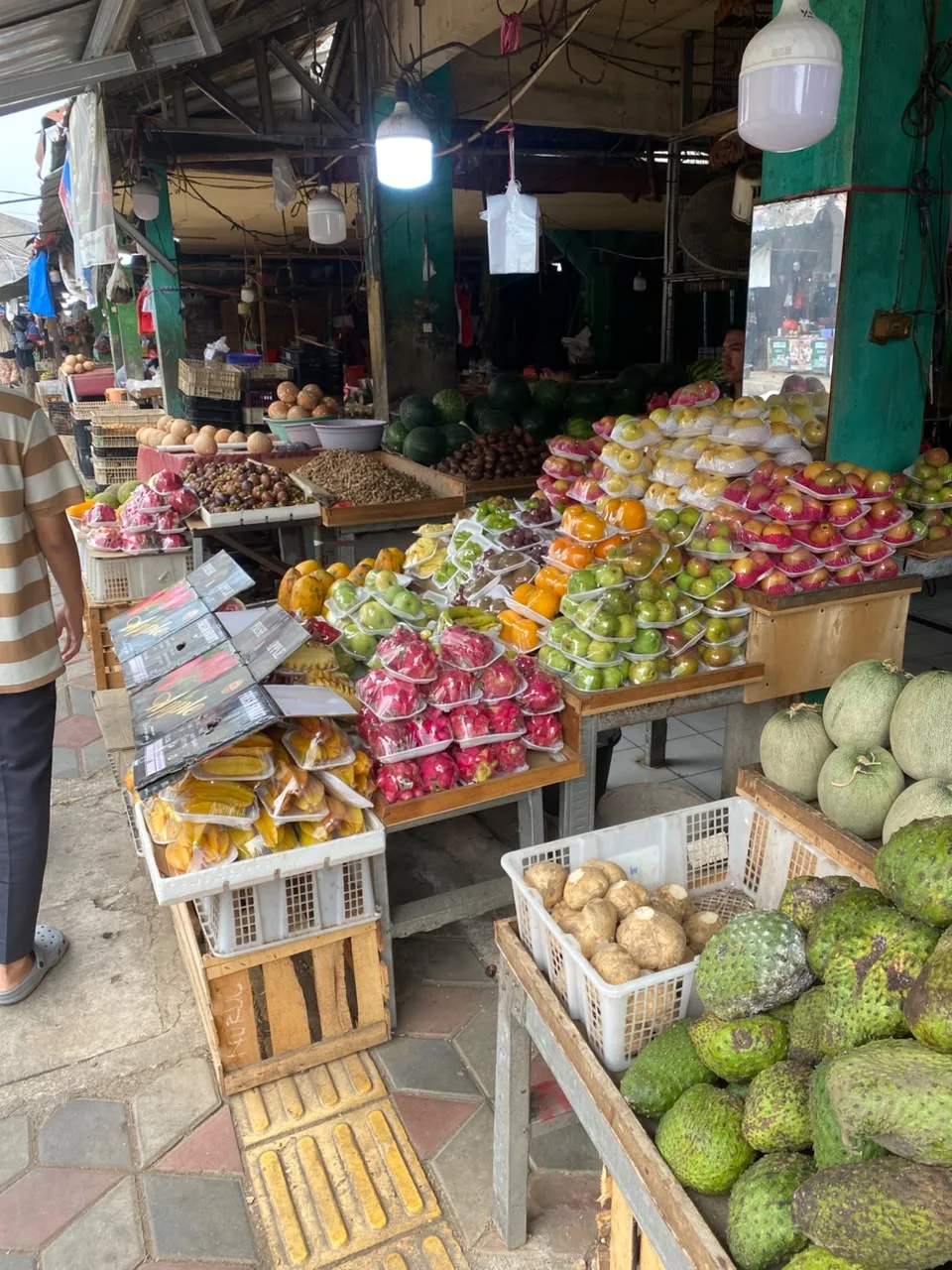
To maintain product quality, fruit vendors at Ciputat Market utilize freezers and special wrappers or paper wrap.
The use of these facilities aims to maintain fruit freshness while increasing its selling value.
Based on interviews, Fitri (45), a fruit vendor, mentioned that her business income ranges from Rp3 million to Rp5 million per day. Meanwhile, Nini (52) reported an income of about Rp1 million per day.
This difference shows the variation in business scale and sales results among fruit vendors in traditional markets.
Government Intervention and Long-Term Challenges
To maintain the stability of staple food prices, the South Tangerang City Government has taken several steps, including price monitoring, market operations, and holding cheap food bazaars.
The Tangsel PAGAR program implemented in February 2026 was said to help curb retail price increases in the market.
However, this intervention has not fully resolved the structural problem of dependency on supplies from outside the region.
In the distribution of cooking oil, the local government also encourages vendors to place orders directly through Bulog by utilizing an application.
As of the end of May 2026, about 40 shops were reported to have been connected to this ordering mechanism (Group 5, 2026).
At the market level, vendors apply various strategies to maintain their businesses. Steps taken include adjusting profit margins based on procurement costs, managing stock volumes, and accepting orders via mobile phones and WhatsApp.
The Group 5 (2026) study assesses that price stabilization efforts in the medium term need to be directed at strengthening regional supply chains, improving quality standards, developing cold storage facilities, and ensuring transparency in production and distribution data.
These steps are considered important so that traditional markets do not just rely on temporary price handling policies.
As long as the dependency on external supplies remains high, changes in production conditions, weather, and distribution will continue to affect food prices at Ciputat Market.
Ultimately, vendors and consumers are the parties who most directly feel the impact, whether through increased business costs or changes in the prices of daily necessities.
Bibliography
Anggraeni, A., Setiadi, A., & Herista, M. I. S. (2025). Analysis of factors affecting broiler chicken meat demand in households in Tembalang District. Mimbar Agribisnis.
https://jurnal.unigal.ac.id/mimbaragribisnis/article/view/23530
Antara. (2026, March 6). Deputy Minister of Trade: Government will regulate the sale of MinyaKita above HET. Antaranews Jogja.
https://jogja.antaranews.com/berita/810975/wamendag-pastikan-penjualan-minyakita-di-atas-het-ditindak
Group 5. (2026). Analysis of supply and demand for food commodities: Eggs, rice, fruit, cooking oil, and broiler chicken at Ciputat Vegetable Market. Microeconomics observation report, unpublished.
Group 5. (2026). Strategic supply issues: Ciputat traditional market, South Tangerang. Course assignment document, unpublished.
Pratiwi, D., Andarwangi, T., Tantriadisti, S., & Ulfah, M. (2025). Market integration and price transmission elasticity of purebred (broiler) chicken meat in Indonesian traditional markets. Mimbar Agribisnis, 11(2), 1739–1745.
https://jurnal.unigal.ac.id/mimbaragribisnis/article/view/17594
RRI. (2026, June 10). Bulog Serang ensures no price increase for MinyaKita. RRI.co.id.
https://rri.co.id/banten/regional/2481042/bulog-serang-pastikan-harga-minyakita-tak-ada-kenaikan



Comments 0
Write a Comment Share your response