


Cobb-Douglas estimates indicate decreasing returns to scale and low capital productivity. Business owners are advised to improve efficiency before increasing investment or taking on new credit.
PANGKALPINANG, JurnalPost.com — Additional capital is often seen as one of the fastest ways for Micro, Small, and Medium Enterprises (MSMEs) to increase production capacity. However, an analysis of halal food MSMEs in Pangkalpinang, Bangka Belitung Islands, shows that the challenges faced are not always due to a lack of capital.
Estimates using the Cobb-Douglas production function reveal that some of the capital already held by business owners has not been utilized optimally. This condition means that additional investment will not necessarily lead to a proportional increase in production.
The estimation results show the sum of the elasticities of the three main inputs—labor, capital, and raw materials—is 0.934. A value below one indicates a condition of decreasing returns to scale or diminishing returns to scale.
This means that when labor, capital, and raw materials are increased simultaneously in the same proportion, the increase in output is expected to be lower than the increase in inputs.
These findings suggest that increasing business capacity cannot be achieved solely by adding resources. The efficiency of input utilization is also a critical factor.
Negative Capital Coefficient Signals Need for Evaluation
One interesting finding concerns the capital variable. In estimations using the Cobb-Douglas production function and Stochastic Frontier Analysis (SFA), the capital coefficient shows a negative value of relatively small magnitude.
These results must be interpreted with caution. A negative coefficient in the model does not necessarily mean that capital always reduces production. However, the findings appearing in both estimation approaches serve as a signal that the capital used by the business owners in the sample has not yet generated an optimal contribution to production.
In other words, the issue that needs attention is not just how much capital is owned, but how that capital is allocated and used in the production process.
A similar condition is seen in the level of technical efficiency. As many as 52 percent of business owners are at an efficiency level of 0.51–0.70, while 27 business owners were recorded as having an efficiency level below 0.7.
These figures indicate that there is still room to increase production using the combination of inputs already available.
One possibility that needs to be evaluated is the use of production equipment that is not yet efficient, machine capacity that is unbalanced with labor, production layout, and raw material management.
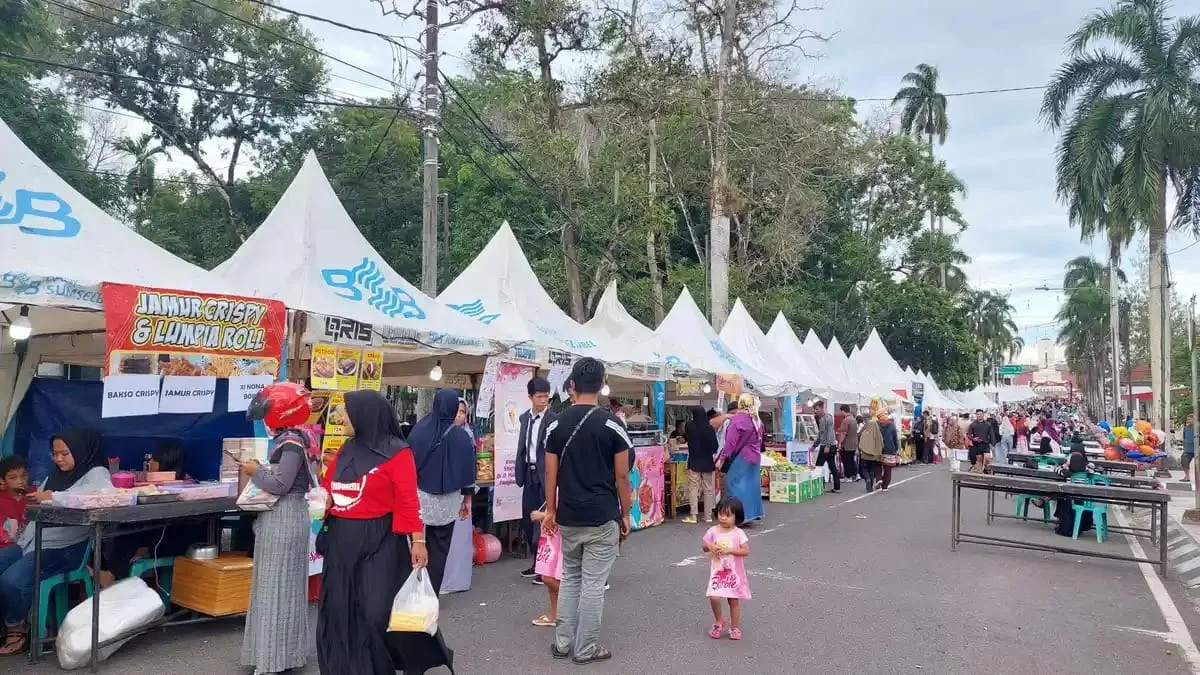
An MSME owner who was a respondent in the study revealed that limited initial capital meant that equipment purchases were made gradually using business revenue.
“The business keeps running, but it is not yet at its maximum,” they said.
A gradual investment pattern does help a business survive. However, if machine capacity, labor, production space, and raw materials do not develop in a balanced manner, some assets may not be used at their best capacity.
Cost Pressures and Business Competition
MSME owners also face external challenges.
Rising raw material prices can squeeze margins in the food and beverage sector, especially for small businesses that have limited ability to raise selling prices.
Competition in Pangkalpinang is also becoming increasingly tight. Based on data from the Pangkalpinang City Office of Cooperatives, MSMEs, and Trade used in the study, the number of MSMEs in 2025 reached 26,875 units, an increase compared to 26,529 units in 2024.
Some of these operate in the culinary and ready-to-eat food sectors.
In such conditions, adding capital without increasing productivity can increase business costs without automatically increasing sales.
Therefore, investment decisions need to consider the market's ability to absorb additional production.
Why Does Additional Capital Not Always Increase Production?
In production theory, there is a concept known as diminishing marginal returns or decreasing marginal returns.
Simply put, adding one type of input does not always produce the same amount of additional output if other inputs do not adjust accordingly.
For example, a production kitchen has two workers and one oven. Buying an additional oven can increase capacity. However, if the number of workers, production space, raw material supply, or market demand remains the same, the second or even third oven may not necessarily be used to its full potential.
This is where the balance between inputs becomes important.
The Cobb-Douglas production function describes production as the result of a combination of various factors, including labor, capital, and raw materials. Technology and management capabilities then determine how productively those inputs are used.
Capital provides capacity, labor operates the production process, while raw materials are the physical inputs being processed.
When one factor increases much faster than others, the productivity of additional capital can weaken.
Do Not Rush to Take Out Credit
The findings of this study have important implications for MSME management: before adding capital or taking on new financing, business owners need to first identify the sources of inefficiency in their operations.
This diagnosis becomes even more important as access to financing becomes more open.
The People's Business Credit (KUR) policy in 2026 is directed at an interest rate of 6 percent per year for productive business owners, with a distribution target of approximately Rp295 trillion. The government is also opening wider access to KUR by removing frequency restrictions for the productive sector.
Ease of financing can help MSMEs grow if the funds are used for truly productive investments.
Conversely, taking out credit to add machines or equipment that are not yet needed can create new burdens in the form of installments, cash flow pressure, and operational costs.
This risk becomes greater when business financial records are not well-maintained.
Data from the 2025 National Financial Literacy and Inclusion Survey (SNLIK) shows Indonesia's financial literacy index is at 66.46 percent, while the financial inclusion index reached 80.51 percent.
This gap shows that access to financial services is quite broad, but the public's ability to understand and use financial products still needs to be strengthened.
Efficiency Can Start from Within the Business
Before making a major expansion, there are a number of steps MSMEs can take to optimize the capital they already have.
First, conduct an efficiency audit. Business owners can record the maximum capacity of equipment, actual production volume, machine operating hours, labor productivity, and wasted raw materials.
Second, direct investment toward value-added activities. Capital should be used for equipment or technology that can truly cut costs, improve quality, accelerate production, or open new markets.
Third, separate personal and business finances. Separate cash flow records will help owners know the condition of the business more accurately.
Fourth, control raw material costs. Business owners can compare suppliers, improve inventory planning, and avoid excess stock that locks up working capital.
Fifth, improve equipment and work procedures. Modernization does not always mean buying expensive machines. Routine maintenance, production space layout, division of labor, and clear standard operating procedures can also increase productivity.
Sixth, expand marketing through digitalization. Utilizing social media, e-commerce, food delivery services, and various digital channels can help match available production capacity with broader market demand.
Halal Certification Deadline Approaching
For MSMEs in the food and beverage sector, the issue of efficiency now runs parallel to the obligation to meet halal certification requirements.
Government Regulation Number 42 of 2024 regulates the phasing of the mandatory halal certification for micro and small business owners for food, beverage, slaughtered products, and slaughtering services until October 17, 2026.
With the current date of October 7, 2026, MSME owners have only about 10 days until the end of the phasing period.
The government, through the Halal Product Assurance Organizing Agency (BPJPH), is also providing a quota of 1.35 million free halal certificates in 2026 through the Free Halal Certification (SEHATI) program for MSMEs that meet the criteria.
For food and beverage business owners, halal certification is not just an administrative matter. Compliance can influence consumer trust as well as product access to a wider market.
Therefore, production expansion should go hand-in-hand with improvements in governance and business compliance.
The findings regarding the low capital productivity of halal food MSMEs in Pangkalpinang ultimately show that business growth is not solely determined by the amount of capital.
MSME development should not stop at credit distribution or equipment assistance. Mentoring in production management, financial recording, technology use, cost control, and efficiency measurement needs to receive equal attention.
For business owners, the most important question before increasing investment is no longer just “how much capital is needed?”, but “is the capital I already have working productively?”



Comments 0
Write a Comment Share your response