

Learning Mathematics from Local Crafts
Mathematics is often perceived as a difficult subject due to its association with numbers, formulas, and calculations. However, mathematical concepts are embedded in everyday life, including traditional crafts. One such example is the pandan weaving industry in East Aceh. This craft not only produces useful goods but also holds the potential to serve as a learning medium that resonates with students' daily lives.
Through pandan weaving, students can learn to identify shapes, lines, patterns, and measurements firsthand. Rather than relying solely on textbook explanations, they can observe tangible objects in their surroundings. This approach connects mathematical material to real-world experiences while introducing local wisdom to the younger generation.
Pandan Weaving: A Local Craft Worth Preserving
Pandan weaving is a craft developed by the community in East Aceh. Rizal, Safrizal, and Fuad (2020) discussed the development of designs and business management for pandan weaving crafts in Alue Dua Muka O Village, Idi Rayeuk District, East Aceh Regency. Their research highlights that this craft also provides economic value to the local community.
Sarah, Novita, and Fitriana (2021) also examined the use of East Aceh pandan leaves for fashion products. This study serves as an example of efforts to diversify local crafts. Such crafts have the potential to be integrated into education, allowing students to appreciate local skills and cultural heritage.
The Mathematics Behind Weaving Patterns
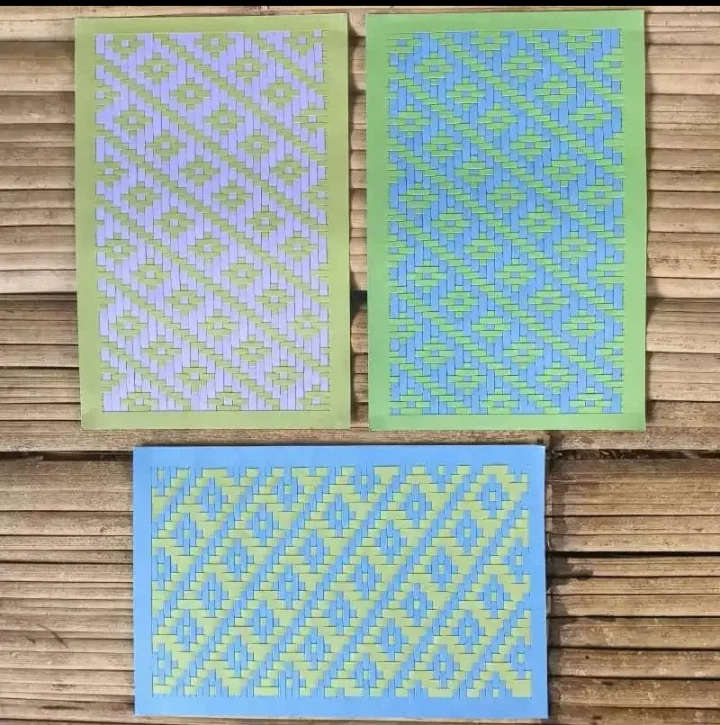
Upon closer inspection, pandan strips are arranged in specific patterns to form the surface of the weave. This arrangement can serve as a practical example for introducing lines, repeating patterns, and measurements. The shape of the finished product can also be observed to study two-dimensional or three-dimensional geometry, depending on the object.
Mubarok's research (2025) on pandan weaving in Grenggeng Village, Kebumen, identified several mathematical concepts, such as plane geometry, solid geometry, parallel lines, right angles, congruence, and similarity. Meanwhile, research by Yulistiyani, Nuraida, and Zakiah (2023) on Rajapolah pandan weaving identified geometric and algebraic concepts, including systems of linear equations in two variables within the context of craft sales.
Both studies demonstrate that pandan weaving can be linked to mathematical material. However, findings from Kebumen and Rajapolah cannot be directly applied to the conditions of pandan weaving in East Aceh. Local patterns and shapes must be observed first to ensure that the mathematical concepts applied are truly relevant.
Bringing Pandan Weaving into the Classroom
Teachers can utilize pandan weaving through simple activities. For instance, students can be asked to observe the arrangement of pandan strips, count them, identify repeating patterns, or measure their length and width. These activities help students understand that mathematics is not confined to textbooks but is present in the objects around them.
Students can also draw weaving patterns on grid paper or observe the shape of woven products to identify geometric figures. Teachers can then connect these observations to the current curriculum. This is an example of a pedagogical approach that can be developed, rather than a specific trial using East Aceh pandan weaving.
Learning Mathematics While Appreciating Culture
Using pandan weaving as a learning medium bridges education and cultural preservation. From an educational perspective, weaving provides concrete examples to explain mathematical concepts. Culturally, it allows students to recognize local crafts and value the skills of artisans. Consequently, learning activities go beyond the curriculum to introduce the cultural richness of their environment.
The use of pandan weaving must be tailored to learning objectives and student age. Teachers should ensure that the shapes or patterns observed relate to the mathematical concepts being taught. If designed appropriately, East Aceh pandan weaving has the potential to be a contextual learning medium and a means to introduce regional culture to the younger generation.
References
Mubarok, M. S. (2025). Ethnomathematics in pandan weaving crafts in Grenggeng Village, Kebumen, as a mathematics learning medium. Al-’Adad: Jurnal Tadris Matematika, 4(1), 1–15. https://doi.org/10.24260/add.v4i1.3714
Rizal, Y., Safrizal, & Fuad, M. (2020). Mentoring for design development and business management of pandan weaving craft products in Alue Dua Muka O Village, Idi Rayeuk District, East Aceh Regency. Global Science Society: Jurnal Ilmiah Pengabdian kepada Masyarakat, 2(2), 434–446. https://ejurnalunsam.id/index.php/gss/article/view/2473
Sarah, M., Novita, & Fitriana. (2021). Application of East Aceh pandan leaf weaving for fashion products. Jurnal Ilmiah Mahasiswa Pendidikan Kesejahteraan Keluarga, 6(4), 1–13. https://jim.usk.ac.id/pkk/article/viewFile/21108/9818
Yulistiyani, D. R., Nuraida, I., & Zakiah, N. E. (2023). Utilization of ethnomathematics in Rajapolah pandan weaving crafts in mathematics learning. J-KIP (Jurnal Keguruan dan Ilmu Pendidikan), 4(2), 577–586. https://doi.org/10.25157/j-kip.v4i2.9045



Comments 0
Write a Comment Share your response