

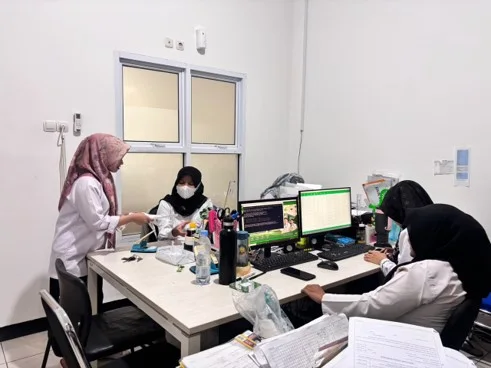
PEMALANG, JurnalPost.com – Occupational health and safety (OHS) 3 is a vital component in supporting safe, comfortable, and sustainable hospital services. Healthcare workers and administrative staff face different occupational risks, requiring prevention efforts tailored to their specific activities and environmental conditions.
In the Medical Records Unit, prolonged computer use necessitates attention to ergonomics and eye health. Meanwhile, nurses directly involved in patient care must understand potential occupational hazards and build habits that support safety.
These two aspects complement each other. Ergonomics helps adapt work, equipment, and environments to the needs of the worker. Meanwhile, a safety culture encourages all staff to recognize risks, follow procedures, communicate effectively, and report incidents and unsafe conditions.
Implementing both can be part of an effort to build a healthier and safer hospital work environment.
Ergonomics and Preventing Computer Vision Syndrome in Medical Records Staff
Medical records staff perform various activities, ranging from recording and processing to tracking and managing patient health information. Work involving repetitive and prolonged computer use must be supported by ergonomic facilities and work habits.
One complaint that needs to be recognized is Computer Vision Syndrome (CVS), which is a collection of eye and vision complaints related to the use of computers or digital devices.
Symptoms that may arise include eye fatigue, dry eyes, blurred vision, and discomfort when looking at a screen. These conditions can be related to the duration of computer use, rest habits, viewing distance, monitor position, and lighting.
However, visual complaints cannot be immediately confirmed as CVS without considering other conditions and contributing factors.
Work ergonomics is not only related to sitting position but also includes monitor placement, keyboard and mouse usage, the suitability of desks and chairs, and lighting adjustments.
Poor posture and the habit of maintaining the same position for long periods can also cause discomfort in the neck, shoulders, back, and other parts of the body.
Ergonomic Practices to Consider
Some simple ergonomic practices that can be applied by medical records staff include:
Sitting position and body posture. Ensure the back is well-supported and the feet are not dangling while working.
Monitor position and viewing distance. Place the screen in a position that is comfortable to view without having to constantly look down or up.
Keyboard and mouse usage. Place devices within easy reach so that the hands do not need to bend excessively or reach too far.
Lighting adjustments. Pay attention to room lighting conditions and reduce glare from lights or reflections on the screen.
Work duration and rest. Balance computer use with appropriate breaks, changes in body position, and simple relaxation.
Safety Culture and Safe Work Behavior for Nurses
In hospital services, nurses need to understand various potential hazards related to biological exposure, the use of sharp objects, chemicals, and physical activity.
Knowledge of hazards and prevention efforts must be supported by a safety culture that is part of daily work.
A safety culture is reflected in the habit of following standard operating procedures (SOPs), using personal protective equipment (PPE) according to risk, communicating about potential hazards, and reporting incidents and unsafe conditions through official mechanisms.
Risky behaviors need to be identified objectively with an orientation toward improving work systems, rather than blaming individuals.
Knowledge of OHS 3 helps nurses recognize hazards and determine appropriate preventive actions. Some aspects to consider include recognizing hazards in the hospital environment, selecting and using PPE according to risk, and applying hand hygiene based on infection prevention and control procedures.
In addition, the handling and disposal of sharp objects must follow applicable procedures. Reporting incidents, exposures, and unsafe conditions is also an important part of building a safer work environment.
The implementation of OHS 3 does not only depend on individual knowledge. Workload, availability of facilities, access to PPE, leadership support, communication between staff, and organizational policies can also influence safety practices.
Therefore, assessment and improvement need to consider the conditions of the work environment and overall system support.
Educational Programs at RSU Comal Baru
Two internship activity designs at RSU Comal Baru highlight education as one of the efforts to support the formation of better work habits.
In the Medical Records Unit, the “HEALTHY MEDICAL RECORDS WORK” program is designed to strengthen the application of ergonomics through initial condition identification, preparation of educational materials, poster creation, socialization, and simple evaluation.
The main messages of the program include sitting position adjustments, monitor position adjustments, comfortable keyboard and mouse usage, attention to lighting and glare sources, and the habit of changing body position and utilizing work breaks.
These messages are expected to serve as visual reminders that are easy to understand and apply according to workplace conditions.
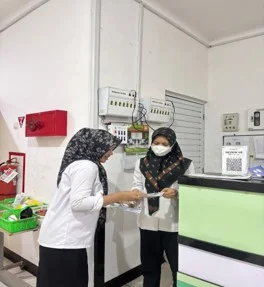
Meanwhile, for nurses, the “NURSE CARE OHS 3” program is designed in the form of socialization and leaflet distribution to support safety culture and safe work behavior.
The activity stages are planned to include coordination with supervisors and related units, identification of educational needs, preparation and validation of materials, implementation of socialization, and evaluation.
Final materials must be adjusted based on the results of the initial identification, then reviewed and approved by the hospital before use.
Identifying needs is an important step so that educational materials are not based on assumptions regarding ergonomic conditions, staff complaints, knowledge levels, or nurse behavior.
Observations must also be carried out in accordance with permits and field conditions, without disrupting services, accessing confidential documents without permission, or collecting patient identities or data.
Evaluation and Program Sustainability
The ergonomics program evaluation is planned to assess the implementation of activities, staff understanding of the material, and the application of simple ergonomic practices after socialization.
Supporting outputs can include ergonomic risk observation sheets, brief educational materials, checklists or practice reminders, and follow-up recommendations for the Medical Records Unit.
In the NURSE CARE OHS 3 program, the evaluation is planned to focus on the implementation process, participant reach, media distribution, and permitted feedback.
Initial indicators may include activity approval, availability of reviewed leaflets, implementation of socialization sessions, recording of the number of participants and leaflets, and the availability of evaluation summaries and recommendations.
Knowledge evaluation before and after the activity is only conducted if the instruments and methods have obtained approval. The results are presented in aggregate and are not used to provide negative assessments of individuals.
All activities must continue to adapt to real conditions in the field, the approval of related parties, SOPs, official hospital policies, and the smooth running of services.
Program sustainability is expected not to stop at the availability of posters or leaflets, but also to open opportunities for utilizing educational media as reminders in daily work activities.
Building a Healthy and Safe Work Environment
A healthy and safe hospital work environment requires the involvement of staff, leadership, and the organization.
For medical records staff, workplace arrangement, lighting, body posture, and rest habits are important aspects that need attention.
Meanwhile, for nurses, hazard recognition, use of PPE according to risk, hand hygiene, handling of sharp objects, compliance with SOPs, and reporting of unsafe conditions are part of responsible work practices.
Through the HEALTHY MEDICAL RECORDS WORK and NURSE CARE OHS 3 programs, education is planned as a contribution to increasing awareness and supporting the improvement of work habits.
These efforts must go hand in hand with the provision of appropriate facilities, clear procedures, effective communication, and organizational support.
With this approach, hospitals can continue to encourage the creation of a more comfortable, healthy, and safe work environment for all staff while supporting sustainable healthcare services.



Comments 0
Write a Comment Share your response