

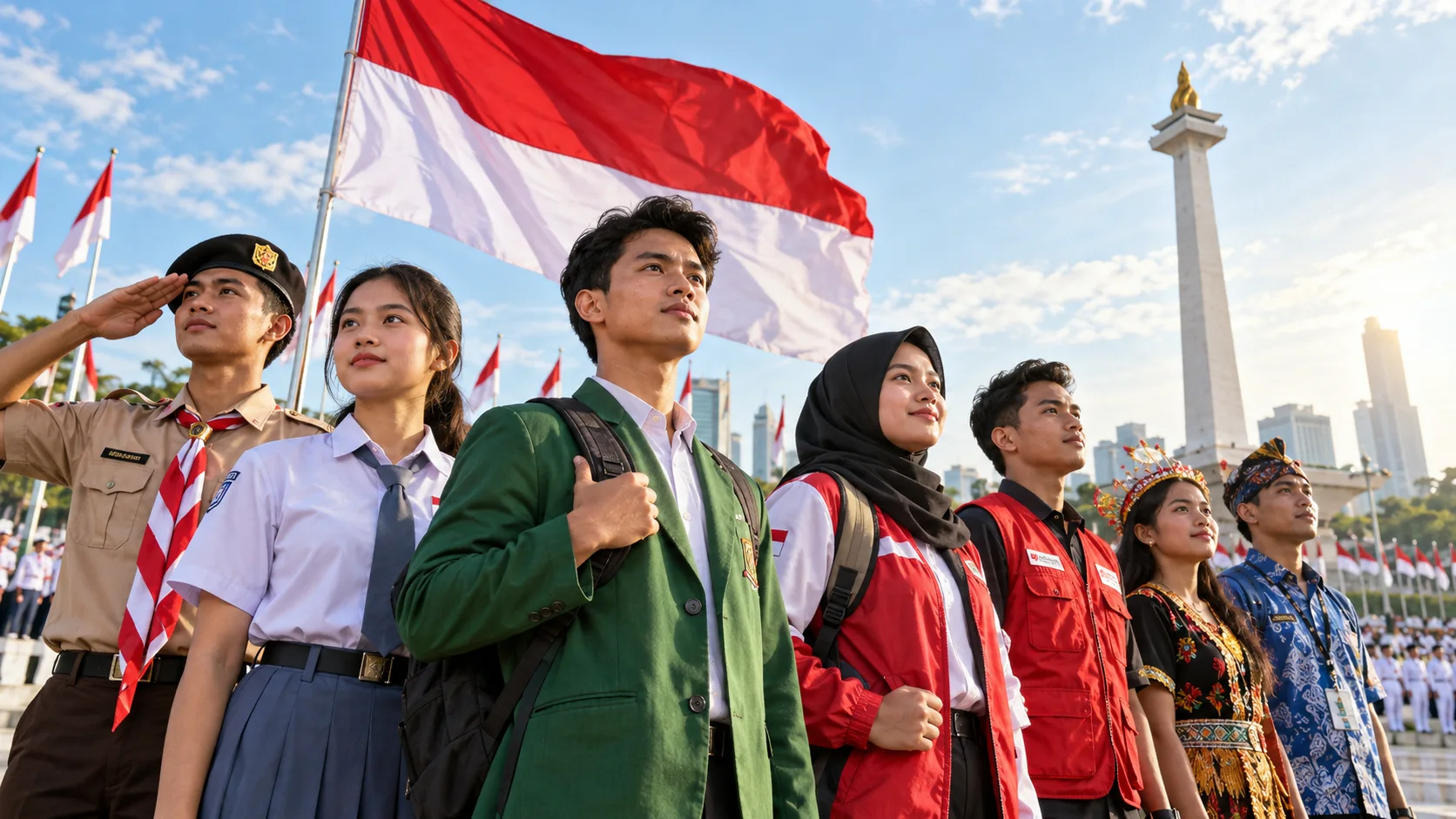
On October 28, 1928, young people from various regions pledged to have one motherland, one nation, and to uphold the language of unity. At that time, Indonesia was not yet a sovereign state; it was merely an idea shared by a collective.
Benedict Anderson described a nation as an imagined community: people who have never met but feel bound by a sense of "us." The Youth Pledge was the moment this community was openly declared. That was where national defense first emerged, long before there was a national army.
At the 98th anniversary of the Youth Pledge, the question is no longer how to seize independence, but how to maintain our unity amidst threats that do not arrive with rifles.
What does the portrait of national defense look like for today's youth? Before answering, one prejudice must be corrected: the assumption that the younger generation lacks love for their country.
National Defense: Both a Right and an Obligation
Our constitution is clear. Article 27 paragraph (3) of the 1945 Constitution and Article 9 paragraph (1) of Law Number 3 of 2002 state that every citizen has the right and obligation to participate in national defense efforts.
Prasetyo et al. (2021) emphasize that national defense is an expression of patriotism that is both a right and an obligation, and the most relevant form today is non-physical national defense.
The sociology of citizenship explains why this is important. T.H. Marshall demonstrated that citizenship consists of civil, political, and social rights. Rights and obligations are two sides of the same membership: citizens who enjoy the protection and services of the state exist in a reciprocal relationship.
Yael Tamir, in Liberal Nationalism, adds that national identity is a source of belonging and shared responsibility rooted in the culture lived by its citizens.
People are willing to sacrifice for their fellow citizens because they feel part of something meaningful. Therefore, healthy national defense grows from a sense of belonging, not from fear or coercion.
The Portrait of Today's Youth: Not Less Love, but a Different Kind of Love
Various studies suggest that the younger generation's awareness of national defense is declining due to the influx of foreign culture and globalization. Some students even view national defense education as merely a formality.
These findings are worth noting, but we should not conclude that love for the country has faded. Other data show a more nuanced picture.
In the Indonesia Millennial and Gen Z Report released by the IDN Research Institute in June 2026, involving 628 millennial and Gen Z respondents across nine regions, 61 percent of respondents cited buying and using local products as their way of loving the country. This was the most popular choice.
Some 59.3 percent believe that criticizing unfair policies is also a form of love for Indonesia. Meanwhile, 62.6 percent are skeptical when nationalism is used for political interests or image-building without real commitment.
This survey was conducted by a media research institute with a limited sample, so it should be read as an indication rather than a national portrait. However, the trend is consistent with official data.
A presentation by the Ministry of Youth and Sports (2025) contains two contrasting figures. About 70.5 percent of youth are involved in social community activities (2023), but only 5.44 percent are involved in formal organizations.
Youth are active, but not always through formal organizational channels. They move through communities, volunteer work, content creation, and consumption.
This represents a shift from structural engagement—such as official institutions, political parties, community organizations, ceremonies, and bureaucracy—toward cultural engagement, such as language movements, local products, creative works, solidarity, and criticism.
Reading This Shift Through Theory
Political sociology has long noted this phenomenon. Russell Dalton distinguishes between dutiful citizenship (obedient, voting, and compliant with authority) and engaged citizenship (critical, self-organizing, and solidarity-based). The younger generation tends to lean toward the latter.
Lance Bennett calls them self-actualizing citizens, citizens who participate through networks, lifestyles, and personal expression, rather than just through institutions.
Pippa Norris calls them critical citizens: citizens who remain supportive of democracy and their nation but are disappointed in its institutions. Their criticism is actually a sign of concern.
Ekman and Amnå (2012) add the concept of latent participation: citizens who appear passive are not necessarily apathetic. They continue to follow issues and are ready to act when needed.
Michael Billig reminds us that a nation is reproduced through banal nationalism, which refers to the daily habits that are almost unnoticed.
In the digital era, that "unfurled flag" can take the form of hashtags, memes, slang, or local community cleanup movements.
Karl Mannheim explained as early as 1928 that a generation forms its own distinct way of acting according to the experiences of its time.
The youth of 1928 expressed nationalism through congresses and organizations because that was the medium of their time. Today's youth do so through mediums suited to their own era.
However, cultural engagement has weaknesses. It can easily stop at mere expression, is fluid, and is difficult to translate into policy. This is where the state plays a role in bridging the gap.
Bridging the Cultural and the Structural
It is better to measure national defense not just by ceremonial activities. In truth, we need three steps.
First, provide space and recognize new forms.
A cross-sectoral coordination framework for youth services should promote safe, inclusive, and non-discriminatory spaces for youth, as well as the involvement of at least 30 percent of the younger generation in the promotion of Pancasila, national defense, national resilience, digital literacy, and the prevention of radicalism.
Community movements, volunteers, and creators need to be recognized as part of national defense and involved from the policy formulation stage.
Second, educate through experience and example, not ceremonies.
National defense needs to be present through role modeling, social work, digital literacy, entrepreneurship, and environmental action, where the values of mutual cooperation and social justice are experienced directly.
One-way national defense education will continue to feel like a formality.
Third, connect cultural energy to structural channels.
The Youth Development Index is currently at around 56 out of 100, while the domains of participation and leadership, as well as employment, remain below 50.
Opportunities remain unequal. Youth from the top expenditure group have a higher education completion rate about four times higher than those in the bottom group.
We have 64.22 million youth (BPS, 2024), with a median age of 29, but the demographic bonus window has only about 13 years left.
If this energy is not channeled, it will become a liability, not a bonus.
Pledging Again, in a New Way
The youth of 1928 did not wait for the state to order them. They acted because they felt a sense of ownership.
Young people today inherit the same spirit, just in a different language. Our task is not to demand they express love in the old way, but to open doors so that this love can meet policy.
At the 98th anniversary of the Youth Pledge, national defense no longer needs to be forced when youth are given space, trusted, and equipped.
It will grow on its own, just like the pledge of the youth in 1928.
Bibliography
Anderson, B. (2006). Imagined communities: Reflections on the origin and spread of nationalism (rev. ed.). Verso. (First edition 1983).
Statistics Indonesia. (2024). Statistik pemuda Indonesia 2024. BPS. https://www.bps.go.id/assets/publication/2024/12/31/b2dbaac4542352cea8794590/statistik-pemuda-indonesia-2024.html
Bennett, W. L. (2008). Changing citizenship in the digital age. In W. L. Bennett (Ed.), Civic life online: Learning how digital media can engage youth (pp. 1–24). MIT Press.
Billig, M. (1995). Banal nationalism. Sage.
Dalton, R. J. (2008). Citizenship norms and the expansion of political participation. Political Studies, 56(1), 76–98.
Deputy for Youth Services, Ministry of Youth and Sports. (2025, May 16). Perubahan atas Perpres No. 43/2022 dan RAN Pelayanan Kepemudaan [Presentation at the Cross-Sectoral Coordination Meeting for Youth Services: Kick Off]. Jakarta.
Ekman, J., & Amnå, E. (2012). Political participation and civic engagement: Towards a new typology. Human Affairs, 22(3), 283–300.
IDN Research Institute. (2026). Indonesia Millennial and Gen Z Report (IMGR). IDN Media. Accessed via IDN Times: https://www.idntimes.com/news/indonesia/riset-imgr-mayoritas-anak-muda-anggap-kritik-bentuk-nasionalisme-00-pnxwk-jkwg48
Kamil, S. I., Nugroho, A. B., & Tarina, D. D. Y. (2023). Pentingnya pendidikan bela negara untuk menumbuhkan nasionalisme mahasiswa Indonesia. Jurnal Multidisiplin Indonesia, 2(6), 926–.
Khodati, S. E., Wahyuni, T. S., & Maftuh, B. (2023). Aktualisasi nilai Pancasila sebagai perspektif kesadaran bela negara pada generasi Society 5.0. Jurnal Pendidikan Kewarganegaraan Undiksha, 11(2), 89–. https://doi.org/10.23887/jpku.v11i2.62363
National Institute of Public Administration. (2019). Wawasan kebangsaan dan nilai-nilai bela negara: Modul I Pelatihan Dasar CPNS Golongan II dan Golongan III. LAN RI.
Mannheim, K. (1928). Das Problem der Generationen. Kölner Vierteljahrshefte für Soziologie, 7(2), 157–185.
Marshall, T. H. (1950). Citizenship and social class and other essays. Cambridge University Press.
Norris, P. (Ed.). (1999). Critical citizens: Global support for democratic government. Oxford University Press.
Presidential Regulation of the Republic of Indonesia Number 43 of 2022 concerning Strategic Cross-Sectoral Coordination for Youth Services.
Prasetyo, D., Manik, T. S., & Riyanti, D. (2021). Konseptualisasi hak dan kewajiban warga negara dalam upaya bela negara. Jurnal Pancasila dan Bela Negara, 1(1), 1–7.
Putri, M. F. J. L., Rahman, A., Rahmawati, E., Ningsih, I. F., & Hidayat, W. (2024). Bela negara sebagai implementasi nilai Pancasila bagi generasi muda. Innovations in Multidisciplinary Education Journal, 1(1), 15–21.
Tamir, Y. (1993). Liberal nationalism. Princeton University Press.
The 1945 Constitution of the Republic of Indonesia, Article 27 paragraph (3).
Law Number 3 of 2002 concerning State Defense, Article 9 paragraph (1).









Comments 0
Write a Comment Share your response