

MALANG, JurnalPost.com — Women with a history of miscarriage require closer attention during subsequent pregnancies. A study by the Midwifery Department at the Faculty of Medicine, State University of Malang (UM), has found a strong correlation between a history of miscarriage and the likelihood of negative pregnancy outcomes, such as further miscarriages or stillbirths.
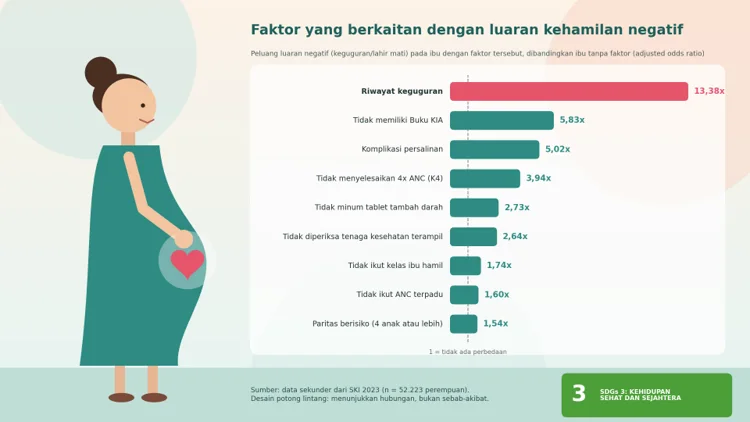
The study, led by Winny Kirana Hasanah, indicates that women with a history of miscarriage are 13.38 times more likely to experience negative pregnancy outcomes compared to those without such a history.
These findings were derived from an analysis of the 2023 Indonesian Health Survey (SKI) data, which involved 52,223 women with pregnancy and childbirth histories between January 2018 and October 2023.
Of the total respondents analyzed, 99.1 percent recorded live births, while 473 women, or approximately 0.9 percent, experienced negative pregnancy outcomes.
Although the proportion is relatively small, researchers emphasize that these findings are crucial for strengthening early detection and healthcare services for pregnant women, particularly those with identified risk factors.
"The percentage is relatively low, but behind those numbers are mothers who have lost their pregnancies. We wanted to identify the most significant contributing factors so that prevention efforts can be more targeted," Winny stated in a research summary received on Tuesday (3/11/2026).
History of Miscarriage as the Most Dominant Factor
In the study, the team analyzed various factors related to pregnancy outcomes, ranging from maternal health history and prenatal check-ups to access to healthcare services.
The analysis results show that a history of miscarriage has the strongest statistical correlation with negative pregnancy outcomes.
Women who have previously experienced a miscarriage were found to have a 13.38 times higher probability of experiencing similar outcomes after adjusting for other factors in the analysis model.
However, this figure does not mean that every woman who has had a miscarriage will inevitably experience another pregnancy loss.
These findings indicate a statistical correlation within the studied group, rather than a definitive prediction for any individual's pregnancy.
Winny explained that a history of miscarriage should be a critical piece of information when healthcare workers conduct initial pregnancy screenings.
"Mothers with a history of miscarriage need to be monitored more closely from the beginning of their pregnancy, rather than being treated the same as standard pregnancies," she said.
More intensive monitoring is expected to help healthcare workers identify conditions that require follow-up examinations or specialized care.
Lack of Maternal and Child Health (KIA) Book Also Linked to Negative Outcomes
In addition to a history of miscarriage, the study identified several other factors associated with negative pregnancy outcomes.
Women who did not possess a Maternal and Child Health (KIA) book were found to have a 5.83 times higher statistical probability of experiencing negative outcomes.
Meanwhile, mothers who experienced delivery complications had a 5.02 times higher probability.
The study also found that mothers who did not meet the minimum of four prenatal check-ups or antenatal care (ANC) had a nearly four times higher probability of experiencing negative outcomes.
Other associated factors include not consuming iron-folic acid tablets, not receiving examinations from skilled healthcare workers, not attending classes for pregnant women, and not receiving integrated antenatal services.
High-risk parity, which in this study included mothers with four or more children, was also found to be associated with negative pregnancy outcomes.
The possession of a KIA book is a point of concern because the document helps record the mother's health condition during pregnancy, examination results, and the child's health development.
However, the statistical correlation between KIA book ownership and pregnancy outcomes cannot be interpreted as the absence of the book being the direct cause of miscarriage.
Social conditions, access to healthcare services, and maternal health characteristics are factors that require further research.
Pregnancy Check-ups Are Not Just About Counting Visits
Another interesting finding relates to the frequency of pregnancy check-ups.
In the multivariate analysis conducted by the team, the indicator of six antenatal visits did not show a statistically significant correlation with negative pregnancy outcomes.
These results do not mean that six prenatal check-ups are unnecessary.
The standard for maternal healthcare in Indonesia continues to recommend a minimum of six prenatal check-ups, with the distribution of visits tailored to the gestational age and the involvement of a doctor for specific examinations.
The research team suggests that the quality of examinations, the timeliness of visits, and the follow-up on identified risks may be more important aspects than the mere number of visits.
"What matters is not just how many times a mother visits, but what is achieved during each visit, ranging from risk screening and counseling to appropriate treatment," said Winny.
Quality antenatal care is expected to identify various health issues early, including anemia, high blood pressure, fetal growth disorders, and other conditions requiring medical attention.
Study Uses Data from More Than 52 thousand Women
The study conducted by the UM team used a cross-sectional approach cross-sectional by utilizing secondary data from the 2023 SKI provided by the Ministry of Health.
Through this approach, researchers were able to identify correlations between various respondent characteristics and pregnancy outcomes.
However, this study design has limitations in explaining causal relationships.
This means that factors found to have a strong correlation with negative outcomes are not necessarily the direct cause of miscarriage or stillbirth.
Further research is needed to understand the mechanisms of these relationships and to evaluate the most effective forms of intervention.
These findings also cannot be used to definitively predict the pregnancy outcome of any individual.
Promoting the Strengthening of Maternal Health Services in Indonesia
The study is part of an effort to support the achievement of the Sustainable Development Goals (SDGs), specifically the third goal regarding good health and well-being.
Indonesia still faces challenges in reducing maternal and infant mortality rates.
Ministry of Health data, referencing the 2020 Population Census Long Form, shows a maternal mortality rate of 189 per 100,000 live births. This figure remains above the SDG target of 2030, which is less than 70 maternal deaths per 100,000 live births.
Although the maternal mortality indicator differs from the negative pregnancy outcomes studied by the UM team, both underscore the importance of strengthening maternal healthcare services.
Based on the research findings, the team recommends improving early detection of high-risk pregnancies, strengthening integrated antenatal services, and ensuring equitable access to examinations by skilled healthcare workers.
The researchers also encourage the use of the KIA book, increased participation in classes for pregnant women, and the provision of iron-folic acid tablets in accordance with needs and healthcare service standards.
"We hope these results can serve as a reference for policymakers and healthcare workers in the field to strengthen antenatal services, especially for the most vulnerable mothers," said Winny.
By strengthening services from the beginning of pregnancy, the team hopes that women with a history of miscarriage or other risk factors can receive health support that is better tailored to their needs.









Comments 0
Write a Comment Share your response