


Batu City, JurnalPost.com — Students of the Muhammadiyah Aisyiyah Community Service Program (KKN MAs) Group 4 held a training session on making Liquid Organic Fertilizer (POC) using goat manure for the Bumi Abadi Utara Farmer Group in Bumiaji Village, Bumiaji District, Batu City, East Java, on Thursday (8/13/2026).
The activity, which took place in the Bumi Abadi Utara Farmer Group's greenhouse, served as a community empowerment program that utilizes local potential, specifically livestock waste, to support more environmentally friendly and sustainable agriculture.
KKN MAs is a program initiated by the Muhammadiyah Central Board as a collaborative platform for students from various Muhammadiyah and Aisyiyah Higher Education Institutions (PTMA) in Indonesia. Through this program, students from various regions carry out community service by highlighting potential and addressing issues in their placement areas.
In 2026, Malang Raya is hosting the KKN MAs implementation. Students from various PTMAs have the opportunity to collaborate and contribute to community empowerment programs in Malang and surrounding areas.
Members of KKN MAs Group 4 come from several universities, namely the University of Muhammadiyah Malang, University of Muhammadiyah Purwokerto, University of Muhammadiyah Riau, University of Muhammadiyah Karanganyar, University of Muhammadiyah Surakarta, University of Muhammadiyah Palu, University of Muhammadiyah Bandung, University of Muhammadiyah Buton, University of Muhammadiyah Bone, University of Muhammadiyah Muara Bungo, University of Muhammadiyah Makassar, and the Ahmad Dahlan Institute of Technology and Business Jakarta.
Encouraging the Utilization of Livestock Waste
This year's KKN MAs implementation carries a spirit of service oriented toward food security and strengthening local potential. This spirit is realized through a number of programs tailored to the conditions and needs of the community in each service location.
In Bumiaji Village, the agricultural and livestock sectors are potentials that can be developed. Goat manure from community livestock activities has the potential to become waste if not managed properly. In fact, this material can be used as a basic ingredient for making organic fertilizer.
This condition is what motivated the KKN MAs Group 4 students to provide training on making goat manure-based POC to the farmer group.
The utilization of goat manure as a POC ingredient is expected to be an alternative for livestock waste management while helping to meet fertilizer needs in agricultural activities.
Through this training, participants not only received theoretical explanations but also the opportunity to practice the POC production process directly so that the knowledge gained can be applied independently.
Farmers Enthusiastically Participate in Training
The activity began with remarks from the Head of the Bumi Abadi Utara Farmer Group, Kalik Harianto. He appreciated the implementation of the training because there were still farmer group members who did not know the process of making liquid organic fertilizer.
“We are very happy with this activity. Many of the farmer group members did not know and had never made liquid organic fertilizer. With this training, we can now know how to make and use it,” said Kalik.
He hopes that the knowledge provided by the students can be applied in daily agricultural activities, thereby providing benefits to the farmers.
After the remarks, the activity continued with a presentation on Liquid Organic Fertilizer by Arlin, a student of the Agribusiness Study Program at the University of Muhammadiyah Bone.
The material included an introduction to POC, the benefits of organic fertilizer, the necessary tools and materials, and the stages of making goat manure-based POC.
The farmers appeared enthusiastic about following the presentation. A number of questions were raised regarding material measurements, the fermentation process, storage time, and how to apply liquid organic fertilizer to plants.
“We came here not to lecture or feel like we know the most. In fact, we also want to learn from you, who are more experienced in farming. Through this activity, we hope to share knowledge and experience,” said Arlin.
She hopes that the activity can provide benefits to the farmer group while also serving as a learning experience for students during their service program.
Direct Practice of Making POC
After the presentation, the activity continued with a demonstration and practice of making POC. Students and farmers practiced every stage, starting from preparing materials and mixing to the fermentation process.
Direct practice was carried out so that participants could more easily understand the production procedure while gaining experience that can be applied again independently.
Interaction between students and farmers remained active throughout the practice session. Participants discussed the composition and dosage of materials, characteristics of the fermentation results, usage time, and how to apply it to plants.
The activity was also attended by the Bumiaji Village agricultural extension worker, Nur Chanifah. Her presence helped strengthen the knowledge exchange process between students, extension workers, and the community in developing agriculture based on local potential.
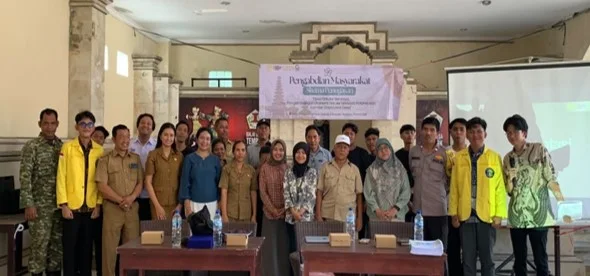
The series of activities then closed with a group photo session. Although the event had finished, a number of farmers continued to discuss with students about the utilization and application of POC in daily agricultural activities.
The enthusiasm of the participants showed the community's interest in utilizing livestock waste into materials that have utility value for the agricultural sector.
For KKN MAs students, this activity was not only a means of sharing knowledge but also a space to learn directly about the conditions, experiences, and needs of farmers in Bumiaji Village.
Through this training, students hope that the knowledge regarding the production of goat manure-based POC can be applied sustainably by the farmer group.
The utilization of livestock waste into organic fertilizer is expected to be a simple step to optimize local potential, reduce waste, and support more environmentally friendly and sustainable agricultural practices.
This activity is also part of the students' contribution to realizing KKN MAs as a collaborative program for PTMAs throughout Indonesia. Collaboration between students from various scientific backgrounds is expected to produce empowerment programs that are relevant to community needs and provide sustainable benefits for the village where they serve.





Comments 0
Write a Comment Share your response