


By: Ayu Manah Sri Wulandari
Student ID 23010330056
Yogyakarta State University
ayu1914fipp.2023@student.uny.ac.id
Sleman – Religious activities are not only a means of introducing spiritual values to children, but they can also be developed as part of a routine that helps build order, focus, discipline, and the ability to follow instructions.
This is evident in the implementation of the Duha prayer at SLB Citra Mulia Mandiri, located in Samberembe Hamlet, Selomartani Village, Kalasan District, Sleman Regency, Special Region of Yogyakarta. This activity has become a routine habit for students at the school, including those with Autism Spectrum Disorder (ASD).
Ayu Manah Sri Wulandari, a student from Yogyakarta State University (UNY), along with her Educational Practice (PK) group members, assisted in the implementation of these activities during their internship at SLB Citra Mulia Mandiri from 20 July to 25 September 2026.
Educational Practice serves as a space for students to apply the knowledge gained during their studies while gaining direct experience in a school environment. During this program, students are not only involved in classroom learning but also assist with various non-teaching activities that are part of the students' daily lives.
Educational practice in a special needs school environment has its own unique characteristics compared to practice in regular schools. Learning approaches, communication methods, media, and forms of support must be tailored to the characteristics and needs of each child with special needs.
One of the activities supported by the students is the Duha prayer routine. This activity is carried out regularly every Monday to Thursday from 07.30–08.00 WIB with the guidance of teachers and university students.
The Duha prayer is conducted in a structured manner. Children are guided through stages starting from performing ablution, preparing prayer equipment, taking their positions, following the movements and recitations, to completing the sequence of activities.
The support provided is not identical for every child. Teachers and students adjust their assistance based on the individual capabilities of each learner. Some children only require simple instructions, while others need direct modeling or physical assistance.
Consistent routines are essential for children with ASD because activities with a clear sequence help them recognize patterns and understand the stages of daily tasks.
In practice, the Duha prayer activity utilizes a direct practice approach or direct practice, modeling (modelling), and structured routines (routinization). Children do not just receive explanations about how to pray; they also observe, imitate, and repeat the same movements regularly.
The sequence of movements in prayer also involves the ability to follow instructions, focus on the examples provided, coordinate body movements, and maintain attention throughout the activity.
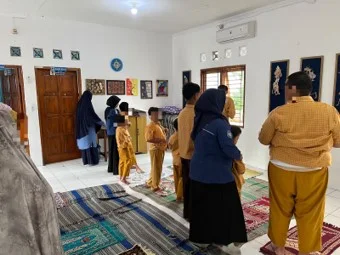
This routine can serve as a means to train motor imitation skills and discipline. The regular implementation also creates a more predictable environment, allowing children to know what to do from start to finish.
Children with Autism Spectrum Disorder have diverse developmental characteristics. Some may experience challenges in communication and social interaction and exhibit repetitive behavioral patterns or a need for specific routines. Therefore, learning activities must be provided through consistent, systematic approaches that align with individual capabilities.
In this context, the Duha prayer is not merely positioned as a religious activity. The routine can also be utilized as part of an educational activity that helps children learn to follow rules, wait for their turn, adapt to group environments, and complete an activity in sequence.
During the assistance process, the involvement of university students provides direct experience in understanding that education for children with special needs requires flexibility. Instructions that seem simple may not be immediately understood by all children, so assistants must observe responses and provide support gradually.
Such activities also serve as an opportunity for students to develop communication skills, classroom management, collaboration with teachers, and the ability to adjust educational approaches based on student needs.
The Duha prayer routine at SLB Citra Mulia Mandiri is also in line with the spirit of inclusive education, which provides opportunities for children with special needs to receive learning tailored to their abilities and needs.
In relation to the Sustainable Development Goals (SDGs), this activity is linked to SDG 4 on Quality Education and SDG 10 on Reduced Inequalities. Quality education is not only related to academic achievement but also includes access to learning processes that are appropriate for the characteristics of each student.
Through religious activities carried out consistently with individual support, children with ASD have the opportunity to develop their spiritual aspects while learning about order, communication, discipline, social interaction, and independence.
Ultimately, the implementation of the Duha prayer becomes part of a broader daily learning experience. It does not just teach the procedures of worship, but also builds positive habits through a process that is repeated, directed, and tailored to the needs of each child.







Comments 0
Write a Comment Share your response