


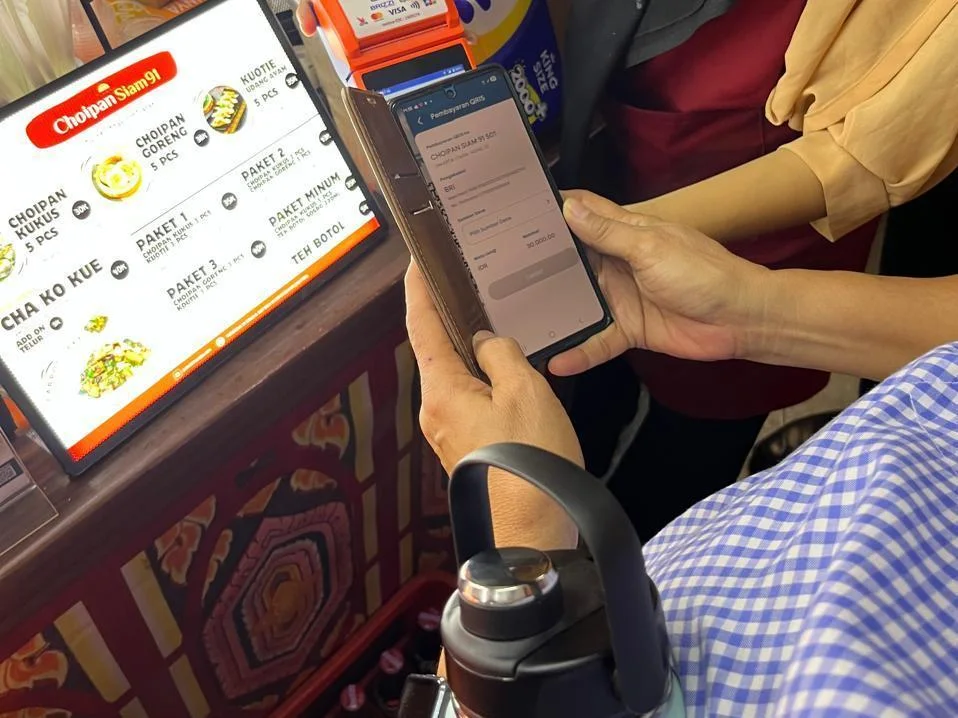
JurnalPost.com - Technological advancements have transformed how people conduct transactions. A foreign tourist enjoying a meal at a small stall in Indonesia no longer necessarily needs to exchange cash or use a credit card. Simply by scanning a QRIS code through a connected payment application, the transaction can be completed in seconds.
Similar convenience is enjoyed by Indonesian tourists when visiting various partner countries. They can make payments using domestic banking applications or digital wallets that support cross-border QR transactions.
This achievement is certainly worth appreciating. The Quick Response Code Indonesian Standard (QRIS) has demonstrated Indonesia's ability to build a digital payment system that is increasingly connected to the international community.
However, a fundamental question arises. Is the success of QRIS enough to declare that Indonesia has achieved rupiah sovereignty in the digital era?
In my view, the answer is no. Monetary sovereignty is not only related to the ease of making payments but also concerns the state's ability to maintain the role of its currency within a continuously evolving financial system.
QRIS has built an efficient transaction pathway. Meanwhile, the Digital Rupiah, developed by Bank Indonesia through Project Garuda, has the potential to become one of the instruments to strengthen the monetary foundation in the future.
Both have different functions, but they can complement each other.
QRIS Opens New Opportunities for the Indonesian Economy
The expansion of cross-border QRIS is part of the national payment system transformation in line with the 2030 Indonesia Payment System Blueprint (BSPI).
This policy continues the development direction of the 2025 BSPI with the goal of strengthening digitalization, payment system integration, and Indonesia's economic connectivity with other countries.
Since the implementation of cross-border QRIS transactions with Thailand in August 2022, its reach has continued to grow. As of 2026, cross-border QRIS has been connected with six countries: Thailand, Malaysia, Singapore, Japan, South Korea, and China.
Bank Indonesia is also preparing to expand payment connectivity with Hong Kong and Timor-Leste.
From an economic perspective, the benefits of this policy are quite tangible, especially for the tourism sector and micro, small, and medium enterprises (MSMEs).
Foreign tourists can make payments in Indonesia using payment applications from their home countries that are connected to the QRIS system. Conversely, Indonesians gain transaction convenience when in partner countries.
For MSME players, this system opens opportunities to accept payments from international consumers without having to provide special international payment card facilities.
This convenience is important because digitalization is no longer just an additional option, but part of the necessity to increase business competitiveness.
Data from Bank Indonesia as of July 2026 shows that cross-border QRIS transactions made by users from partner countries in Indonesia or inbound reached Rp5.90 trillion.
Meanwhile, transactions by Indonesians in partner countries or outbound were recorded at Rp1.73 trillion.
Thus, there is a difference of approximately Rp4.17 trillion between the value of inbound and outboundtransactions. The value of incoming transactions is more than three times higher than outgoing transactions.
This figure shows the high usage of QRIS by consumers from partner countries when making payments in Indonesia.
Although this transaction difference cannot be directly equated to net foreign exchange additions in the balance of payments, the condition still shows the economic opportunities generated by cross-border payment connectivity.
For the tourism and MSME sectors, the easier it is for consumers to make payments, the more open the opportunity for transactions to occur.
However, this success has not answered all of Indonesia's monetary sovereignty issues.
Payment Convenience Does Not Mean Full Sovereignty
The success of QRIS must be placed proportionally. The continuously increasing value of cross-border transactions is indeed encouraging, but it is not enough to change the entire structure of the international payment system.
As an illustration of the scale of the economy, the Central Statistics Agency (BPS) recorded Indonesia's Gross Domestic Product (GDP) at current prices throughout 2025 reached Rp23,821.1 trillion.
That annual GDP figure is conceptually different from the cumulative value of cross-border QRIS transactions. Nevertheless, the scale comparison reminds us that the expansion of QRIS is still just one part of a much larger digital economic transformation.
Another thing that needs to be understood is that QRIS is not a currency.
QRIS is a QR code-based payment standard that facilitates transactions through payment service providers. When someone scans a QRIS code, the funds still originate from the account or payment instrument used, then are processed through the related payment system infrastructure.
In other words, QRIS regulates how payments are made, not by creating a new form of money.
Its existence does indeed strengthen the independence of the national payment infrastructure. However, this strengthening still needs to be complemented by the development of monetary instruments that match the needs of the digital economy.
This is where it is important to distinguish between payment system sovereignty and currency sovereignty.
Indonesia already has the rupiah as its official currency within the framework of national law and monetary policy. However, the development of financial technology presents new challenges, especially as payment innovations and digital assets continue to grow globally.
If the state does not anticipate these changes, there is a risk of reduced relevance for central bank money in the digital transaction ecosystem in the future.
In my opinion, this is the reason why the success of QRIS should not be the end point of national payment system innovation.
Digital Rupiah as a Strengthening of Monetary Sovereignty
The next step that needs attention is the development of a Central Bank Digital Currency (CBDC), which in Indonesia is known as the Digital Rupiah.
Unlike electronic money, which is a liability of its issuer, the Digital Rupiah is designed as money in digital format issued directly by Bank Indonesia.
With these characteristics, the Digital Rupiah becomes a direct liability of the central bank to its holders according to the design and provisions that will apply later.
Bank Indonesia is designing the Digital Rupiah as a complement to money already in circulation, not to replace paper money, coins, or all payment instruments used by the public.
Its development includes two main forms, namely wholesale Digital Rupiah for transactions and settlement in certain financial sectors, and retail Digital Rupiah which is designed for wider use by the public.
The presence of central bank digital money has the potential to strengthen transaction settlement efficiency, increase financial infrastructure resilience, and maintain the role of the rupiah in the development of the digital economy.
However, the Digital Rupiah is not yet available for use by the general public.
Through Project Garuda, Bank Indonesia has carried out a number of exploration stages. One of its important achievements is the completion of the proof of concept (PoC) first phase in December 2024 for the development of the wholesale Digital Rupiah cash ledger.
The testing focused on technological readiness in supporting the issuance, destruction, and transfer of Digital Rupiah in a limited environment.
The results serve as a basis for further development and testing. However, the success of technology testing does not mean the Digital Rupiah is ready to be issued and used widely.
Regulatory readiness, infrastructure, security, and public acceptance are required before implementation can be carried out.
This means that the Digital Rupiah is not an instant solution, but a long-term policy investment to maintain the resilience of Indonesia's monetary system.
Digital Rupiah Risks Cannot Be Ignored
Although it offers a number of potential benefits, the development of the Digital Rupiah also faces various challenges.
One of them is the need for investment in technology and cybersecurity. As an instrument issued by the central bank, the Digital Rupiah must have a system that is reliable, secure, and capable of maintaining transaction continuity.
Risks of data leaks, operational disruptions, and cyberattacks are issues that need to be anticipated from the design stage.
In addition, there are questions regarding its impact on the banking industry.
If retail Digital Rupiah is available at some point and the public can move large amounts of funds from bank deposits to central bank digital money, this condition has the potential to affect bank fund collection.
The impact certainly depends heavily on the design, ownership limits, distribution mechanisms, and terms of use.
Therefore, the development of the Digital Rupiah is not enough to just consider technological superiority. Financial system stability and the public interest must remain a priority.
Bank Indonesia has used a phased approach through public consultation, concept testing, and plans for prototype development and limited trials.
In my opinion, this caution is the right step.
However, caution should not turn into an excuse to stop innovation. Precisely through measured testing, potential weaknesses can be found before a policy is applied more broadly.
QRIS and Digital Rupiah Need to be Prepared to Connect
If QRIS is an infrastructure that makes it easier for the public to make payments, the Digital Rupiah can be developed as a form of money that supports the needs of the future financial system.
Both do not have to be viewed as mutually exclusive projects.
In my opinion, Bank Indonesia needs to start studying the possibility of interoperability between the payment infrastructure that has developed, including QRIS, and the Digital Rupiah architecture.
Such planning is important so that technology development does not run separately and create expensive adjustment needs when integration is required.
However, the integration of QRIS with the Digital Rupiah does not have to be a forced goal. Its needs, benefits, security, and efficiency still need to be proven through testing.
At the initial stage, attention can be directed to the suitability of technology standards, transaction settlement mechanisms, user data protection, and the relationship between the central bank and payment service providers.
The next step is to strengthen the public's digital financial literacy.
The success of payment system transformation is not only determined by the sophistication of the infrastructure, but also by the public's ability to understand and utilize it.
MSME players, people in the regions, and groups that are not yet accustomed to using digital financial services need to get the same opportunities.
Without equal access and understanding, the progress of the payment system actually has the potential to widen the gap between groups of people who are digitally connected and those who are left behind.
The expansion of cross-border QRIS should also not only be directed at supporting tourism, but also consider the potential for trade and economic relations with Indonesia's strategic partners.
Thus, its benefits can reach a wider sector.
Rupiah Sovereignty is a Continuous Process
In the end, QRIS has proven that Indonesia is capable of building a payment standard that is widely used and connected to other countries' payment systems.
This success is an important foundation for strengthening national digital economic independence.
However, rupiah sovereignty cannot be measured only by the number of QRIS transactions, the number of partner countries, or the ease with which the public scans payment codes.
Sovereignty also demands the state's readiness in facing changes in the form of money, developments in financial technology, and risks that arise in modern payment systems.
The Digital Rupiah offers one possibility to strengthen that readiness. Nevertheless, its application must still consider security, financial stability, economic benefits, and the public interest.
I view that Indonesia's biggest challenge is not choosing between QRIS and the Digital Rupiah, but ensuring that both develop in a mutually supportive policy direction.
QRIS has paved the way for the independence of Indonesia's payment system. Now, the challenge is to ensure that the rupiah maintains a strong position in every development of financial technology.
Because rupiah sovereignty is not just about who owns the payment system, but also about the state's ability to maintain trust, stability, and control over its own currency.
Rupiah sovereignty indeed does not stop at QRIS.









Comments 0
Write a Comment Share your response