


Depok, JurnalPost.com — Introducing healthy eating habits to children does not always require lengthy explanations. Simple methods, such as listening to illustrated stories, playing with food images, and arranging menus on paper plates, can turn learning into a fun experience.
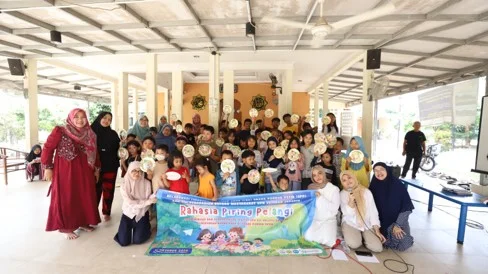
This approach was implemented by the Community Service (PKM) team from the Universitas Pembangunan Nasional “Veteran” Jakarta (UPNVJ) through a nutrition education event titled “The Secret of the Rainbow Plate” at the Al-Hidayah prayer room courtyard in Graha Pondok Petir, Depok, on Sunday (11/10/2026).
A total of 46 children participated in the event, which was organized in collaboration between UPNVJ and the Child-Friendly Environment (LRA) community of Graha Pondok Petir.
This activity is part of the program “Implementation and Mentoring of the Healthy Edu Kit through the Child-Friendly Environment Program in Graha Pondok Petir”, which aims to introduce healthy eating habits from an early age through interactive learning media.
The program was carried out by a PKM team led by Lusia Handayani, along with Vina Mahdalena, Fajaria Nurcandra, and Rini Riyantini. Several UPNVJ students and the management of LRA Graha Pondok Petir were also involved in its execution.
Learning Nutrition Through Stories and Games
The event began with a group exercise session to build a fun atmosphere before the children participated in the learning series.
Afterward, participants underwent an initial evaluation, followed by the reading of an illustrated storybook titled “The Secret of the Rainbow Plate.”
Through this story, children were introduced to the importance of consuming a diverse diet and understanding the functions of various food types for the body.
The material continued with an introduction to food groups using educational posters.
Children were invited to identify staple foods, protein-rich side dishes, vegetables, and fruits as part of a balanced nutritional menu.
Instead of just listening to explanations, participants also had the opportunity to practice the knowledge they had just acquired.
One activity that drew significant attention was the creative game “Assemble My Rainbow Plate.”
In this game, each child chose food images and pasted them onto a paper plate according to their understanding of a nutritious meal composition.
Facilitators helped the participants identify food groups while engaging them in discussions about their daily menu choices.
Through these activities, children were not only introduced to the names and types of food but were also encouraged to understand the importance of dietary diversity.
The learn-through-play approach was chosen so that health messages could be more easily accepted by children in accordance with their experiences and developmental stages.
Healthy Edu Kit Introduced to Parents
Nutrition education in this activity did not stop with the children in attendance.
The UPNVJ PKM team also involved parents and caregivers so that learning about healthy eating could be continued within the family environment.
One of the media introduced was the Healthy Edu Kit, a learning package consisting of illustrated stories, educational posters, and a habit monitoring sheet or habit tracker titled “The Rainbow Plate Challenge.”
This media was designed as a tool to help families reinforce health messages through simple activities at home.
For example, parents can encourage children to identify the food they consume daily, discuss menu choices, and record eating habits using the monitoring sheet.
In this way, nutrition education does not only occur during the event but can be continued through family guidance.
In feedback provided after the event, several parents expressed their appreciation for the learning methods used.
Some parents shared their initial experiences using the educational media at home.
Some attached the monitoring sheet to the refrigerator door so it would be easily visible to the children. Others encouraged their children to add a star sticker after practicing healthy eating habits.
One parent also reported that their child had started to be willing to try vegetables after participating in the activity.
However, these experiences are still initial reports from parents and do not yet constitute a measurable evaluation of changes in the children's eating behavior.
The implementation team introduced the media as a habit-forming tool that can be continuously used and developed with the family.
Collaboration Between UPNVJ and the Child-Friendly Environment
The implementation of the activity received support from the management of LRA Graha Pondok Petir, which has been a partner in executing community-based programs.
The head of LRA Graha Pondok Petir, Titi, expressed her appreciation for the collaboration with the UPNVJ team and the involvement of the children and families in the series of activities.
In addition to nutrition education, the activity also introduced the habit of carrying a personal water bottle or tumbler.
This habit serves as a simple form of learning about environmental awareness by reducing the use of single-use beverage containers.
Thus, children not only gained learning experiences about nutritious food but were also introduced to daily behaviors that are more environmentally friendly.
The involvement of parents, caregivers, students, and community managers was an important part of the activity's execution.
This collaborative approach allowed health messages to be delivered through an environment close to the children's daily lives.
For the university, this activity also serves as a space to apply knowledge and skills in directly addressing community needs.
Building Healthy Eating Habits from an Early Age
Introducing balanced nutrition to children is part of an effort to build healthy lifestyle habits from an early age.
However, an understanding of nutritious food cannot always be formed through one-way information delivery.
Children need experiences that help them recognize food, understand its benefits, and connect that knowledge with daily habits.
Through the “Secret of the Rainbow Plate” activity, the UPNVJ PKM team sought to provide a learning experience closer to the children's world.
Illustrated stories, posters, menu-arranging games, and habit-tracking sheets were used to ensure the learning process could take place interactively.
Meanwhile, the involvement of parents is expected to help maintain the continuity of learning after the event concludes.
The collaboration with LRA Graha Pondok Petir also opens opportunities for the educational materials to be reused in community activities.
The Healthy Edu Kit program is expected to be a means of expanding family access to nutrition information that is easy to understand and apply.
Through simple activities like arranging food images on paper plates, children are invited to recognize that maintaining health can start with daily food choices.
From the family and community environment, these habits are expected to continue to grow and become a part of the children's lives in Graha Pondok Petir.




Comments 0
Write a Comment Share your response