


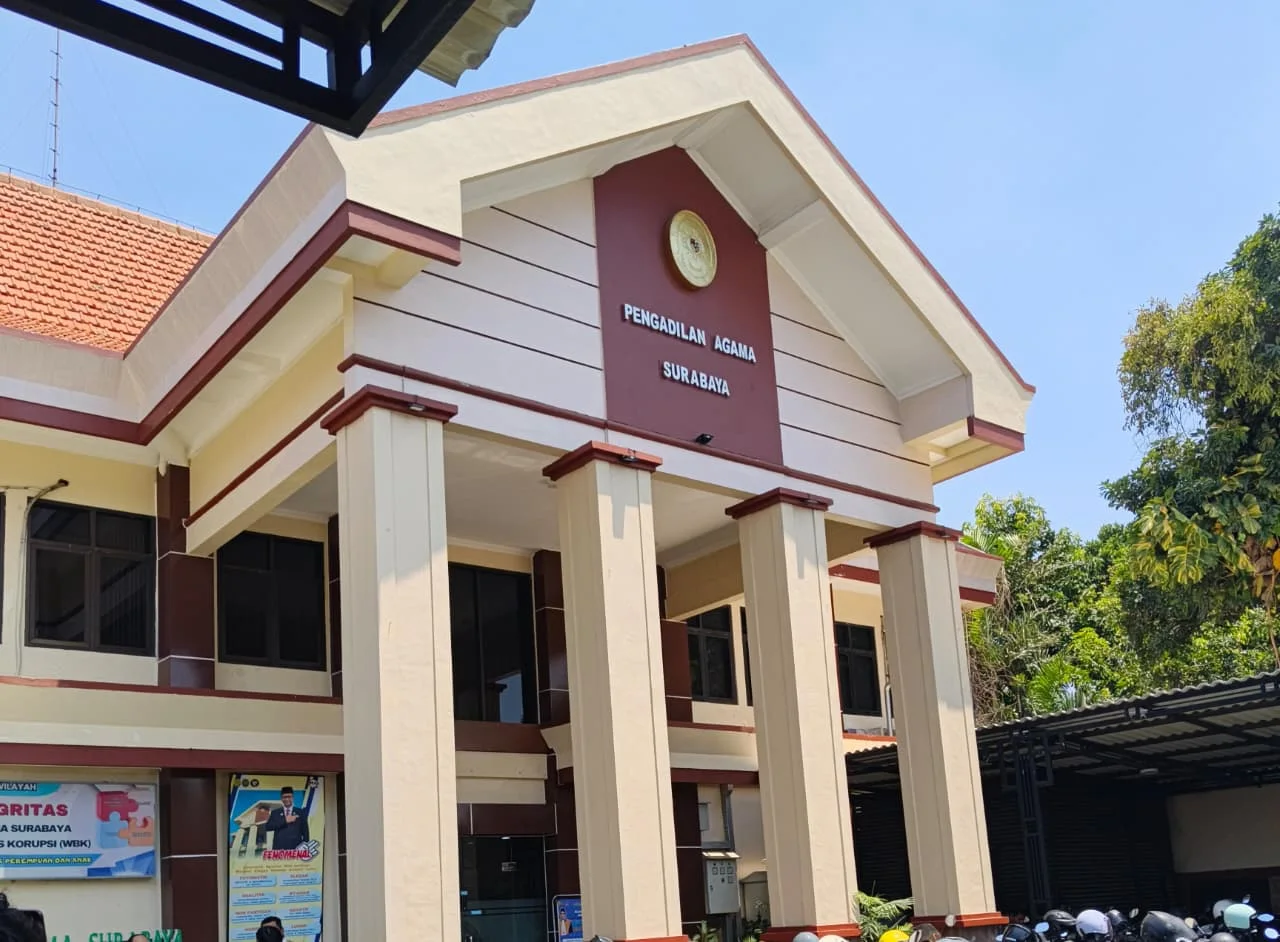
Surabaya, JurnalPost.com — Rows of chairs in the waiting room of the Surabaya Religious Court have been occupied since early morning. Visitors sit waiting to be called with folders of documents in hand, while staff move back and forth to address various inquiries.
This atmosphere was observed on Monday, October 5, 2026, when the author attended a court observation session as part of an assignment for the Faculty of Law at the University of 17 Agustus 1945 Surabaya.
From these observations, the most common cases encountered were divorce proceedings. One recurring sight was hearings attended by only one party, while the other remained absent.
High Divorce Rates
The impression from the waiting room aligns with the case data at the Surabaya Religious Court.
Throughout 2025, the Surabaya Religious Court received approximately 6,080 divorce filings, an increase compared to the previous year, which recorded 5,644 cases. This means there is an average of more than 500 divorce filings every month.
Of that total, divorce petitions filed by wives dominated with 4,469 cases, while divorce requests filed by husbands reached 1,611 cases.
The spokesperson for the Surabaya Religious Court noted that the dominance of wife-initiated divorce petitions is not unique to Surabaya but is found in almost all religious courts across Indonesia.
Regarding the causes, economic factors are still cited as one of the primary issues underlying divorce filings in Surabaya.
Hearings Attended by Only One Party
In several observed hearings, it was common to see only the plaintiff or petitioner present in the courtroom, while the other party did not appear despite having been summoned.
Under civil procedural law, parties are officially summoned through mechanisms regulated by legal provisions, whether via a bailiff or other valid means of notification.
If the defendant does not appear without a valid reason after being officially and properly summoned, the judge may examine and decide the case in their absence in accordance with applicable regulations.
A judgment rendered under such circumstances is known as a default judgment.
However, the absence of the defendant does not automatically result in the petition being granted. The judge must still consider the basis of the claim, evidence, and witness testimony presented during the hearing.
The absence of one party can also affect the mediation process. Fundamentally, mediation is an opportunity for parties to seek an amicable resolution with the assistance of a mediator.
However, this process is difficult to implement optimally if one party is not present.
The reasons for the absence of parties can vary. It is possible that someone has moved, encountered obstacles in receiving the summons, or has chosen not to participate in the court process.
The exact cause differs for every case and cannot be concluded solely based on observations in the court waiting room.
Getting to Know e-Court as an Alternative Court Service
Amidst the busy court services, the Supreme Court has provided electronic case administration services through the e-Courtsystem.
This service is regulated under Supreme Court Regulation (Perma) Number 1 of 2019, which was later amended by Perma Number 7 of 2022 concerning Electronic Case Administration and Court Proceedings.
The system can be used for handling civil cases, including those within the religious court jurisdiction.
e-Court provides four main services, namely:
e-Filing, which is the electronic registration of cases.
e-Payment, which is the electronic payment of case filing fees.
e-Summons, which is the electronic summoning or notification to parties in accordance with regulations.
e-Litigation, which is the implementation of court hearing stages electronically.
e-Court services can be used by registered users and other users. Registered users are generally advocates, while other users include members of the public managing their own cases.
For those who do not yet have an account, the registration process can be assisted through e-Court services at the court according to established procedures.
In general, the process begins with account creation and verification, case registration via the application, receipt of the cost breakdown or e-SKUM, electronic payment of fees, and receipt of court summons according to the established mechanism.
Although digital services are available, in-person service still plays an important role, especially for those who need guidance in understanding legal procedures.
Members of the public who wish to learn about using e-Court for specific cases can request information from the One-Stop Integrated Service (PTSP) officers at the Surabaya Religious Court.
A Message to the Public
Attendance at hearings is an important opportunity for every party to present statements, provide responses, and defend their rights and interests before a judge.
Therefore, those who receive an official summons from the court should not ignore it.
If there are obstacles or a lack of understanding regarding court procedures, the public can seek information through PTSP officers or official court information services.
Observations at the Surabaya Religious Court provide a picture that the divorce process is not only related to the dissolution of a marriage but also concerns the fulfillment of rights and legal certainty for the parties involved.
Divorce is not just a statistical figure. Behind the thousands of recorded cases, there are families facing problems and major decisions in their lives.
The court serves as a place for the public to seek resolution and legal certainty regarding these issues.







Comments 0
Write a Comment Share your response