


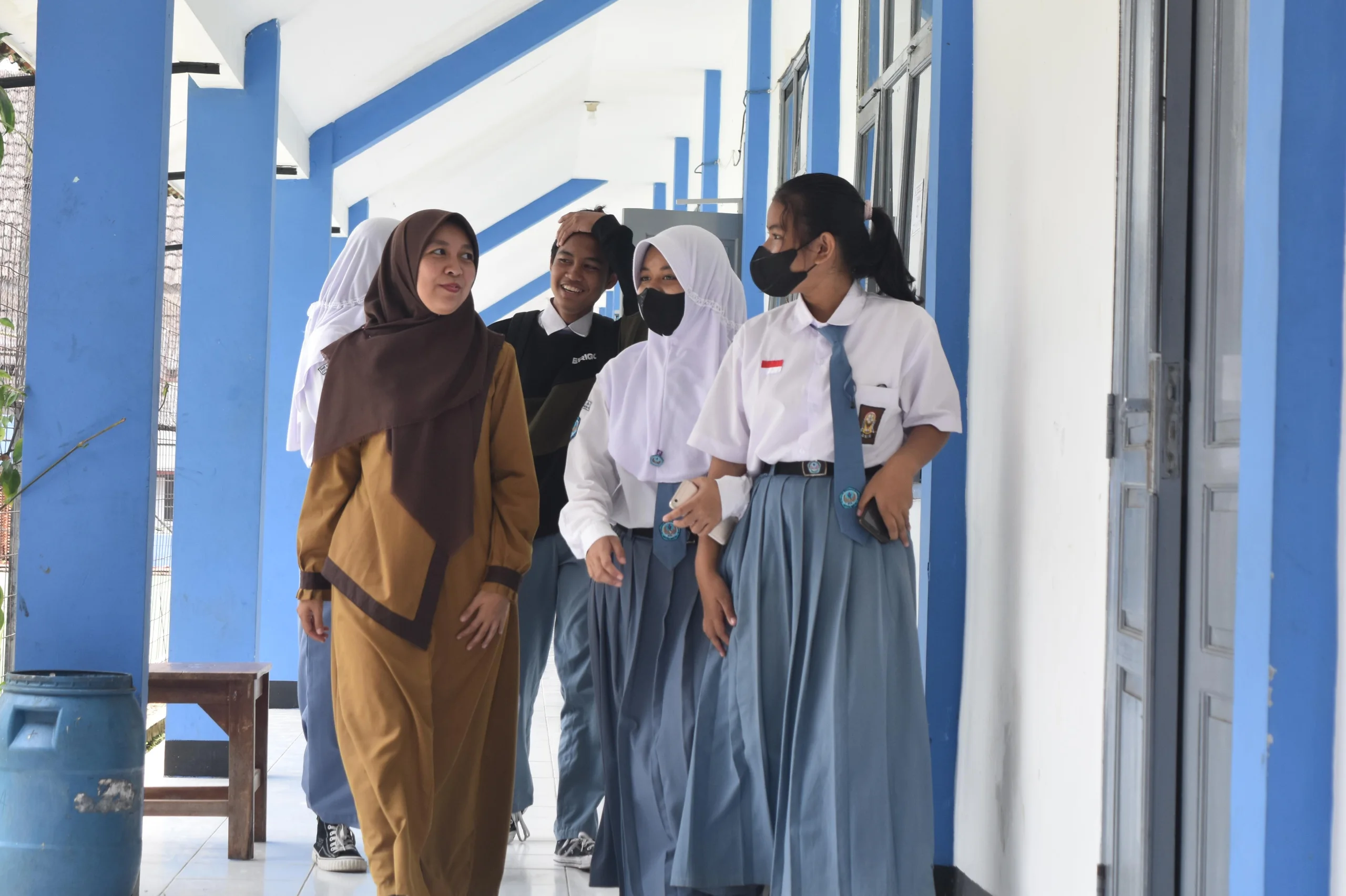
JurnalPost.com - Many parents and teachers lately share the same anxiety: children simply ask artificial intelligence ( AI ), and then stop thinking. That anxiety is understandable. Tasks that once took hours can now be completed in seconds. However, I argue that this anxiety is often misplaced. It is not AI that makes teenagers lazy, but rather how they—and how we—treat this technology.
The reason is simple. Research in Indonesia provides a much more complex picture than the assumption that AI destroys the thinking abilities of young people. A survey of 177 eleventh-grade students at three public high schools in Bandung found a positive and significant influence of AI usage on critical thinking skills, provided the technology is utilized wisely.
Another study of eleventh-grade students at three public high schools in the same city noted a relationship classified as quite strong, with a coefficient of determination of 0.436. These findings indicate that AI should not immediately be considered an enemy to be removed from the classroom.
To me, these findings make sense. Teenagers who are shy about asking questions in class now have a patient study partner that is available at any time and does not laugh at questions deemed trivial. They can ask for explanations repeatedly, complete with examples closer to their daily lives. For some students, this convenience becomes a gateway to understanding material that previously felt difficult or even intimidating.
Even so, I am not saying that AI is inherently beneficial. A study of 216 eleventh-grade students at SMA Negeri 1 Kauman provides a lesson that I believe is the most important. AI usage was reported to have a positive effect on student creativity, but the regression coefficient was only 0.006. Meanwhile, critical thinking ability had a regression coefficient of 0.620.
These findings show that creativity cannot be built solely by relying on technology. Critical thinking skills continue to play a vital role in helping students develop ideas and utilize the information obtained.
I realize that these studies are based on surveys in several schools, so the results cannot necessarily be generalized to all students in Indonesia. The statistical findings must also be read carefully because the relationship between variables does not always prove cause and effect. However, these various findings provide a reason to view the issue of AI usage more critically, rather than just assessing how often students open an application.
Researchers also noted an interesting pattern. Students with good critical thinking skills tend to use AI as a spark for ideas, whereas students with low critical thinking skills are more at risk of using it as a shortcut.
The tool is the same, but the way it is used and the results obtained can differ.
It is at this point that we need to be honest. When teenagers use AI as a shortcut, we must not stop at the conclusion that they are lazy. We need to ask whether they have ever been taught how to ask good questions and whether schools still value the correct answer more than the process of finding it.
If assessment only focuses on the final result, it is not surprising that students choose the fastest way to complete assignments.
The context of Indonesian education also needs to be considered. The 2022 Programme for International Student Assessment (PISA) results show that the average creative thinking score of Indonesian students is 19 points, still far below the OECD average. This data reminds us that the challenge in developing students' thinking skills is not a problem that only emerged after AI became popular.
Pointing to AI as the main cause of the decline in thinking power is indeed easy. However, such a view also risks making us ignore more fundamental educational issues.
We have actually faced similar situations before. Calculators, search engines, and online dictionaries were once suspected of making people stop learning. However, in their development, these tools actually became part of educational activities. The main issue is not merely the existence of technology, but how humans are taught to use it.
Of course, the risks of using AI remain real and should not be underestimated. AI can produce incorrect information, and even convey those errors in very convincing language. Teenagers who are not used to verifying information have the potential to accept wrong answers without questioning them.
Furthermore, the habit of copying answers without understanding their content can eliminate the opportunity to weigh, try, make mistakes, and correct understanding. In fact, it is these processes that help form reasoning abilities.
However, a total ban is not the right answer. If AI is banned in schools but still used secretly at home without guidance, teenagers actually lose the opportunity to learn how to use technology responsibly.
Imagine two students who get the same essay assignment. The first student asks AI to write the entire essay, then copies and submits it without making any significant changes.
Meanwhile, the second student compiles their own writing outline, asks AI to point out weaknesses in their arguments, and then improves the writing using their own understanding and words.
Both use AI. However, the learning process they go through is very different. The second student has a greater opportunity to develop thinking skills, construct arguments, and evaluate their ideas.
What distinguishes the two is not the technology, but the thinking habits when using that technology.
Therefore, I propose several simple steps. For teenagers, the habit of critical thinking can begin by trying to solve problems first before asking AI. After having a tentative answer, they can ask AI to evaluate or point out potential weaknesses.
Teenagers also need to get used to asking questions like "why" and "how," not just "what is the answer." Even asking AI to refute one's own opinion can be an exercise in seeing an issue from a different perspective.
Important information provided by AI should also be re-checked through books, scientific journals, or official sources that can be held accountable.
For teachers, school assignments should not only assess the final answer but also consider the student's thinking process. For example, by asking students to explain the steps to the solution, the reasons for choosing an answer, and how they arrived at a certain conclusion.
Meanwhile, parents can invite children to discuss things learned through AI. This approach is more beneficial than simply banning the use of technology or letting children use it without supervision.
Schools also need to foster digital literacy from an early age so that students are accustomed to evaluating information critically, rather than just consuming it. Without that ability, no matter how sophisticated the technology used, we will only be training teenagers to be passive recipients of answers.
Indeed, building thinking habits like this might feel slower at first. However, thinking takes time, and speed is not the only measure of success in learning.
Precisely when we are willing to be a little slower, there is room for curiosity to grow. Understanding gained through the process of asking, trying, and evaluating is usually more meaningful than instant answers that are easily forgotten.
In the end, the question of whether AI is good or bad for teenagers is, in my opinion, not quite right. The more important question is: have we equipped teenagers with critical thinking skills before handing over technology this powerful to them?
AI will continue to evolve and become part of daily life. It is critical thinking skills that help teenagers remain in control of technology, not the other way around.
Our task is to ensure that teenagers remain capable of thinking, questioning, considering, and making decisions independently.
Isn't that what we should expect from education? Not just producing children who are good at answering, but a generation that dares to question the answers.








Comments 0
Write a Comment Share your response