

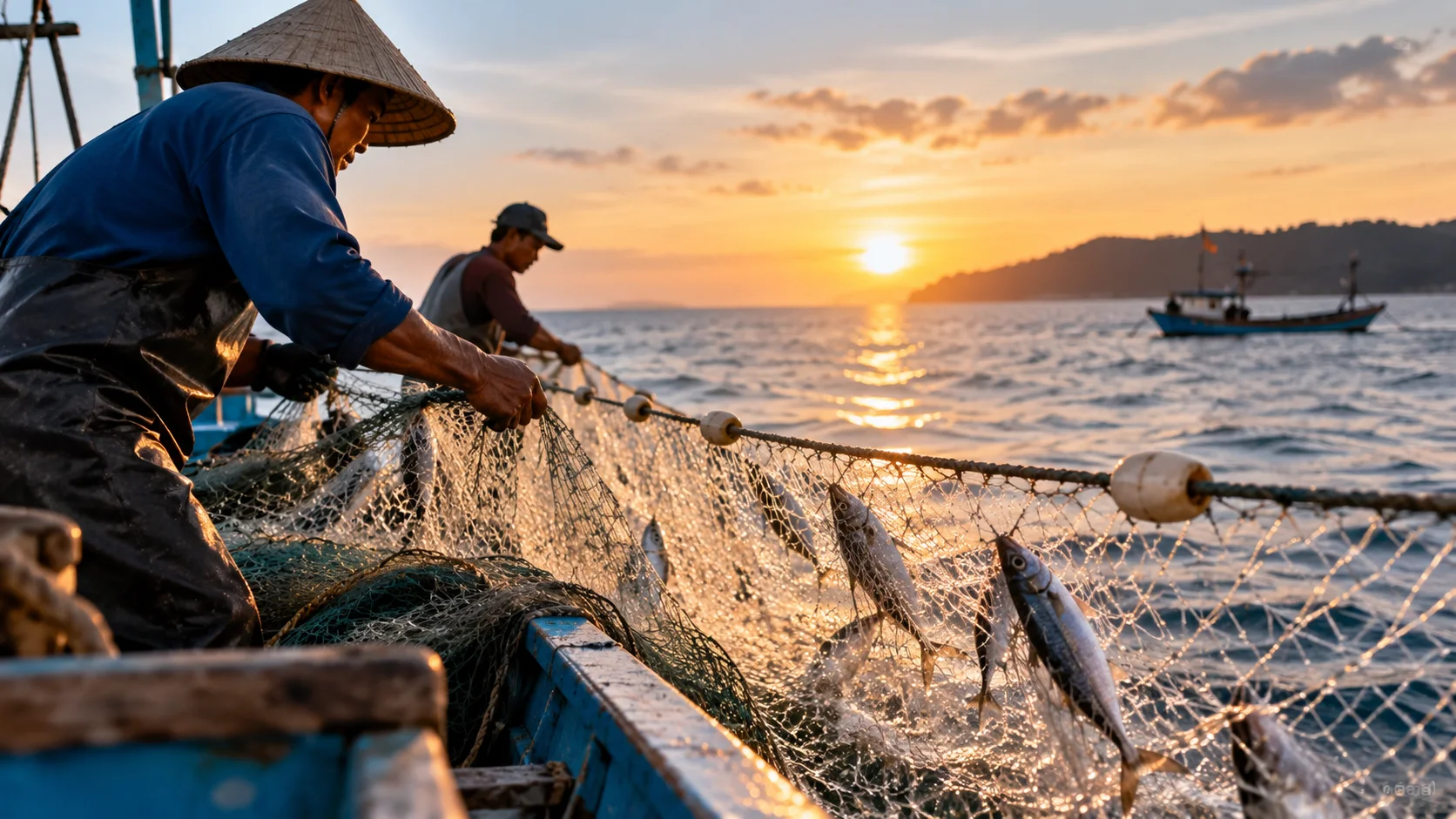
JurnalPost.com - Amidst the variety of modern fishing technologies, gillnets remain one of the most widely used fishing gears by Indonesian fishers. Their construction is simple, their operation is relatively easy, and their use can be adapted to water conditions and target fish species. For small-scale fishers, gillnets are not just fishing equipment, but a vital part of their strategy to secure a catch and support their families.
Technically, gillnets are rectangular fishing gears consisting of a net body, head rope, foot rope, floats, and weights. Based on their operation, this gear is categorized into fixed gillnets (fixed gillnet) and drift gillnets (drift gillnet). Fixed gillnets are set in specific positions in the water, while drift gillnets are left to move with the current or water flow according to the operational method.
The name gillnet comes from the word gill and net . This naming relates to the fishing principle of ensnaring fish by the head or body, specifically around the gills. When a fish passes through a mesh of the appropriate size, it becomes entangled and struggles to escape. This mechanism allows gillnets to be used for catching various types of fish, including pelagic species that inhabit the water column.
Some fish species frequently targeted by gillnets include ribbonfish, mackerel, and scad. However, the success of a catch is not determined solely by the type of gear. Mesh size, setting location, weather conditions, currents, and the fishing season all influence the quantity and type of fish obtained. Therefore, a fisher's knowledge of water characteristics and fish behavior is a crucial factor in determining the success of fishing operations.
In addition to variations in operational methods, gillnets also differ based on the number of net layers. A single-layer gillnet has a relatively simple construction. Meanwhile, a three-layer gillnet is known as a trammel net, which consists of two outer layers with larger mesh sizes and one inner layer with a smaller mesh size. This arrangement allows fish to be caught through different mechanisms, including when the net forms a pocket after the fish passes through the layers.
An example of gillnet usage can be found in Pangandaran, West Java, which has capture fisheries activities with distinct local characteristics. Local fishers are familiar with gear types such as the 'ciker' net. Knowledge of fish seasons is also an important part of their fishing activities. One example is the capture of ribbonfish, which are known to be abundant during certain periods, including around September based on the experience of some local fishers.
This experience shows that capture fisheries activities depend not only on tools and technology but also on local knowledge developed through experience. Fishers learn the right time to go to sea, determine where to set their nets, and adjust their strategies based on changes in catch results.
In the local language, the head rope and foot rope parts of a gillnet are known as 'eris.' This term highlights the close relationship between fishing technology, identity, and the customs of coastal communities.
However, the popularity of gillnets must be balanced with attention to the sustainability of fish resources. The use of inappropriate mesh sizes can increase the risk of catching small fish or non-target species. Nets that are lost or abandoned at sea also have the potential to continue catching marine organisms.
Therefore, fishers need to use appropriate mesh sizes, comply with fisheries regulations, and manage and maintain their gear so it does not become a source of marine pollution.
These issues are directly related to the Sustainable Development Goals or Sustainable Development Goals (SDGs), specifically SDG 14: Life Below Water . This goal encourages the conservation and sustainable use of marine resources.
One of its targets, Target 14.4, emphasizes science-based fishing management, the prevention of overfishing, and the eradication of illegal and destructive fishing practices. Meanwhile, Target 14.b emphasizes the importance of small-scale fishers' access to marine resources and markets.
Thus, fisheries sustainability must go hand-in-hand with the protection of fishers' livelihoods (United Nations, SDG 14).
The implementation of SDG 14 in fisheries activities should not stop at campaigns to protect the ocean. The government, fisheries extension workers, researchers, and fisher groups need to strengthen ecosystem-based fisheries management.
Information regarding fish seasons, changes in catch, fish size, and environmental conditions needs to be recorded and integrated with scientific data. Fishers also need to receive adequate support and market access so that sustainable fishing practices do not become an economic burden for them.
Ultimately, gillnets deserve to be called one of the mainstay fishing gears for Indonesian fishers because of their simple construction, flexible use, and the diverse range of fish that can be caught. However, the success of fisheries should not be measured solely by the amount of fish brought home. Success is also determined by the ability to maintain a balance between economic needs, ecosystem preservation, and the sustainability of livelihoods.
Gillnets can continue to support the lives of fishers if used responsibly. In line with SDG 14, protecting the ocean does not mean stopping fishing activities, but ensuring that marine resources remain available for future generations.
Prosperous fishers and a healthy ocean must be two goals that move forward together.
About the Author: Nurani Khoerunnisa is a lecturer at the Faculty of Fisheries and Marine Sciences, Universitas Padjadjaran. She has a keen interest in fisheries, particularly fishing technology, the utilization of marine resources, and the importance of sustainable fishing practices to support the welfare of fishers and the preservation of marine ecosystems.







Comments 0
Write a Comment Share your response