

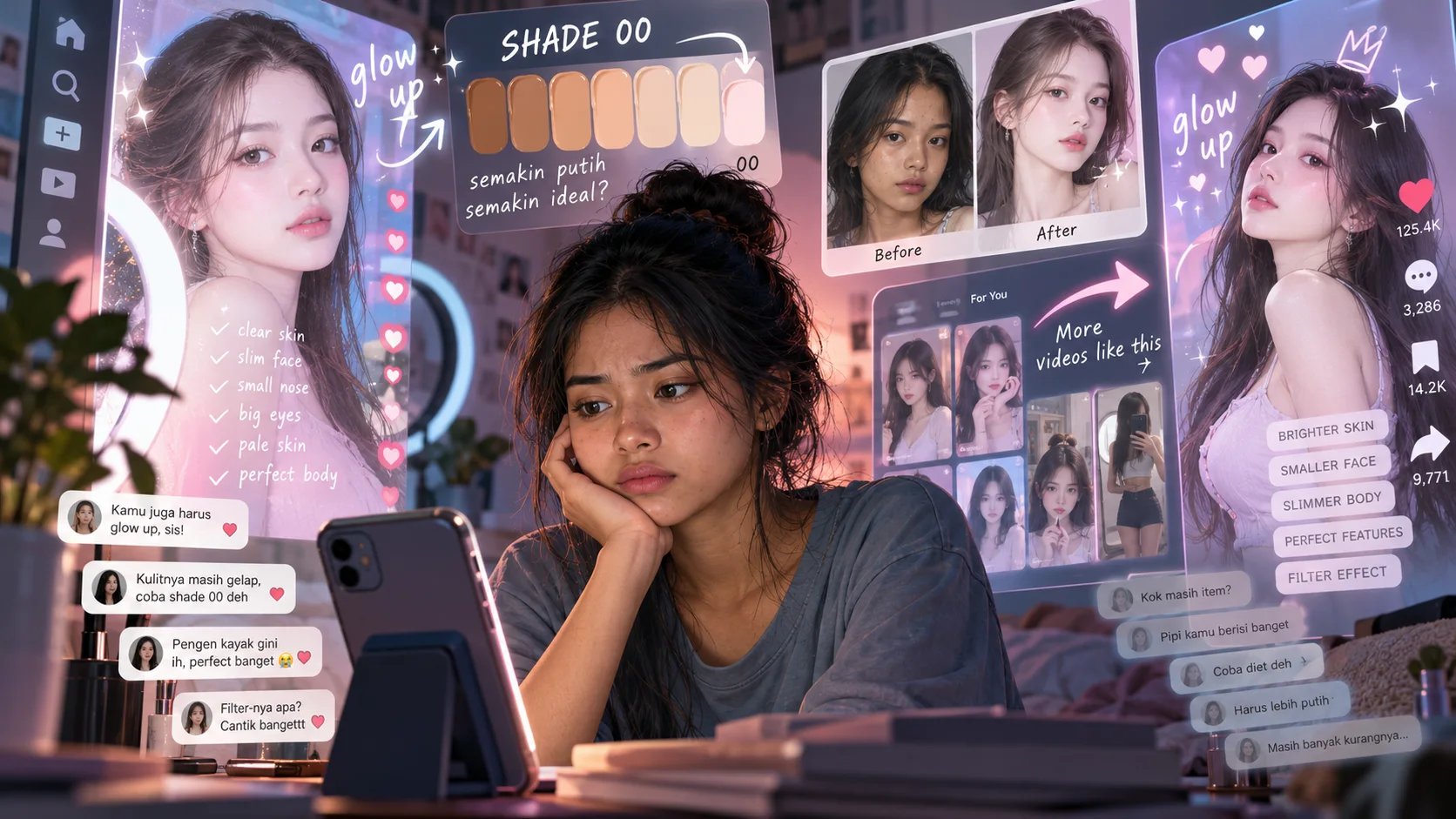
JurnalPost.com In the digital era, TikTok is no longer just an entertainment app for watching short videos, following dance trends, or seeking information. For many young people, this platform is slowly becoming a space that shapes how they view appearance, including defining what constitutes a beautiful woman.
Beauty standards that were once largely shaped by television, magazines, and advertisements are now easily found on mobile screens. Every day, users are served content featuring skincare, makeup tutorials, physical transformations, and various beauty trends that promise an ideal face and body.
According to the 2026 Indonesian Internet Penetration and Usage Behavior Survey conducted by the Indonesian Internet Service Providers Association (APJII), TikTok is the most frequently accessed social media platform by respondents, at 31.8 percent. This figure highlights the powerful position TikTok holds in the digital lives of Indonesians.
However, behind its popularity lies an issue that warrants critical examination. The beauty content that constantly circulates has the potential to narrow the understanding of women's appearance. Fair skin, symmetrical faces, slim bodies, and flawless looks are frequently promoted as the ideal image of beauty.
As a result, what should be a personal choice can slowly turn into social pressure.
The 'Shade 00' Trend and Narrowing Beauty Standards
One phenomenon that illustrates this issue is the TikTok trend titled 'Let's Aim for Shade 00.'
The term shade 00 generally refers to the lightest color in a specific cosmetic product line. In this trend, very fair skin is often presented as the beauty goal to be achieved.
At a glance, this trend might be considered entertainment or a form of user creativity. However, when viewed through a critical lens, questions arise regarding the message being conveyed to women.
Why is lighter skin constantly portrayed as the desired beauty standard? Are women with tan or dark skin then considered to fall short of this standard?
This phenomenon cannot be separated from the culture of colorism, which is the differential treatment or judgment based on skin color, including the tendency to privilege lighter skin.
When one skin tone is continuously promoted as a symbol of beauty, women with other skin tones risk feeling that their natural appearance is a flaw that needs to be corrected.
A similar issue is seen in the glow uptrend. Fundamentally, changing one's appearance is not inherently wrong. Everyone has the right to take care of themselves, use cosmetics, or change their style as they wish.
However, the problem arises when such changes are depicted as if they have only one goal: to meet a specific beauty standard.
In various pieces of content, the appearance before a glow up is often shown as an unattractive condition, while the appearance afterward is considered a better version of oneself.
In reality, these differences are often influenced by lighting, camera angles, makeup, and digital filters.
Consequently, the line between real appearance and modified imagery becomes increasingly difficult to distinguish.
When Algorithms Shape Beauty Standards
Through the perspective of critical feminism, media cannot be viewed as a space entirely detached from power relations and economic interests.
This view aligns with discussions in communication and gender studies that see media as part of the process of forming and disseminating social values.
In the context of TikTok, the issue is not merely that women upload beauty content, but how the content distribution system can reinforce specific images of the ideal body.
The For You Page (FYP) recommendation system allows users to receive content based on various interaction signals and preferences. Content that gains significant attention has the potential to reach more users.
When videos about fair skin, slim bodies, or physical transformations consistently attract attention, similar content becomes increasingly visible to specific groups of users.
However, this does not automatically prove that the TikTok algorithm is specifically designed to prioritize women with certain physical characteristics.
What needs to be criticized is how content dissemination mechanisms, user habits, and commercial interests can interact to reinforce beauty standards already prevalent in society.
In gender studies, this condition can be linked to the concept of hegemonic femininity, where certain images of femininity gain a dominant position and are more socially valued.
Women who are perceived to meet these standards may receive greater recognition, while those with different appearances must face social judgments that are not always fair.
As a result, beauty is no longer just a matter of personal taste, but is also linked to the pressure to conform to societal expectations.
Women's Bodies and the Demand to Always Look Perfect
This issue can also be understood through the theory of gender performativity developed by Judith Butler.
In her book Gender Trouble (1990), Butler explains that gender identity is related to actions and social practices that are constantly repeated, rather than something formed naturally.
When linked to beauty culture on TikTok, this theory helps explain how images of the ideal woman can be continuously produced through habits and visual representations.
Women seem to be faced with the demand to always maintain their appearance, follow cosmetic trends, use specific products, and present the best version of themselves on camera.
Such activities are certainly not a problem if done by personal choice. However, when a feeling arises that one must do so to be accepted or considered beautiful, there is social pressure that needs to be questioned.
In such a situation, beauty can turn into something that must be constantly proven.
Women are not only expected to look attractive but also seem required to maintain that appearance at all times.
Standards like these have the potential to create pressure, especially for teenagers who are still in the process of building their identity and self-confidence.
The Impact of TikTok on How Women View Their Bodies
Exposure to repetitive beauty content is also related to issues of body image. body image.
When someone sees an appearance deemed ideal too often, the possibility of comparing themselves to others arises.
This process is known as social comparison .
Many social media users question their face shape, skin color, weight, or physical appearance after viewing content from creators and influencers.
In psychology, this issue is also related to self-objectification, which is the tendency for someone to view and judge their body based on the perspective or judgment of others.
Research by Bunga Aisya and Rinaldi (2026) in PAEDAGOGY: Journal of Educational Science and Psychology examined the relationship between self-objectification and body dissatisfaction among 148 female teenage TikTok users in Padang.
The study highlights the potential link between the tendency to judge the body through others' perspectives and dissatisfaction with physical appearance.
Although correlational research does not in itself prove a cause-and-effect relationship, this issue remains important to note.
If women constantly feel they must compare themselves to others' appearances on social media, it has the potential to affect how they accept and value their own bodies.
Comments regarding body shape, skin color, or facial features can also worsen the situation.
Remarks like 'You'd be prettier if you were thinner' or 'Why don't you just whiten your skin?' might be considered casual comments by some.
However, such comments actually reinforce the notion that women's bodies are objects free to be judged and corrected based on others' standards.
Beauty Is Not a Competition to Be Won
In my view, TikTok should be a space that gives women the opportunity to express themselves freely, not a place that makes them feel they must meet a single beauty standard.
There is nothing wrong with using skincare products, trying new makeup, or following glow uptrends. Every woman has the right to determine how she wants to present herself.
However, such choices need to be distinguished from social pressure that makes someone feel they are not beautiful enough if they do not follow certain trends.
The main issue lies not in women's desire to look attractive, but in the assumption that only one form of appearance deserves recognition.
When women have to spend a lot of time adjusting their faces with digital filters or feel their self-worth is determined by the number of likes and comments, we need to re-examine the meaning of beauty being constructed.
A woman's body is not a race object that must be constantly judged based on visual standards.
Skin color, face shape, body size, and other physical characteristics are part of human diversity that should not be treated as flaws.
The Importance of Digital Literacy and Self-Acceptance
Facing these issues, media literacy is an important step, especially for the younger generation.
TikTok users need to understand that content appearing on the FYP does not always reflect reality. Lighting, editing, filters, and camera angle choices can produce an appearance different from reality.
This awareness is necessary so that users do not use every beauty content piece as a benchmark to judge themselves.
Content creators also have a moral responsibility to be more careful in conveying messages about beauty.
Content promoting self-care should not be built by demeaning skin color, body shape, or specific physical characteristics.
Additionally, campaigns for self-acceptance and appreciation for diverse appearances need to be continuously strengthened.
Digital platforms also need to encourage transparency regarding filter usage, especially filters that can significantly alter a person's face or physical characteristics.
With clearer information, users can distinguish between content showing natural appearance and visuals that have been modified.
Ultimately, beauty standards are not absolute truths. These standards are formed through social, cultural, economic, and media representation processes that are always subject to change.
Women have the right to define beauty based on their own views and comfort, without having to submit to social pressure or the popularity of digital trends.
TikTok may present millions of beauty videos every day. However, algorithms, user comments, or viral trends should not be the determinants of a woman's value.
Because beauty should not be measured by how fair the skin color is, how perfect the face is on camera, or how much recognition is gained on social media. Beauty also exists in diversity, freedom of choice, and a woman's courage to accept herself.
References
Aisya, B., & Rinaldi, R. (2026). The relationship between self-objectification and body dissatisfaction among female teenage TikTok users. PAEDAGOGY: Journal of Educational Science and Psychology, 6(2), 1440–1450. https://doi.org/10.51878/paedagogy.v6i2.11010
Indonesian Internet Service Providers Association (APJII). (2026). 2026 Indonesian Internet Penetration and Usage Behavior Survey.
Butler, J. (1990). Gender Trouble: Feminism and the Subversion of Identity. Routledge.
Tripalupi, M. F. (2026). Communication and Gender. Untag Surabaya Press.









Comments 0
Write a Comment Share your response