

Did you know? In 2024, the U.S. Surgeon General raised concerns regarding the impact of social media usage on adolescent mental health. There have even been proposals to include warning labels on social media platforms, similar to those found on cigarette packaging.
This serves as a reminder that technological progress does not always come without challenges. Amidst the various conveniences offered by the digital world, we need to question whether technology is truly helping us grow or if it is making us increasingly dependent on it.
Current technological developments make student learning activities feel more practical. One example is the presence of Artificial Intelligence (AI), which can assist in understanding material, finding writing ideas, and providing help in completing assignments. Information that previously took quite a long time to find can now be obtained in a matter of seconds.
However, the ease of obtaining instant answers also raises questions. Is technology truly helping us understand material better, or is it making us more accustomed to completing tasks without going through a deep thinking process?
AI: Helping Us Understand Material or Making Us Dependent?
AI has become a part of current student learning habits. When we find material that is difficult to understand, we can ask AI to explain it using simpler language. AI can also help find ideas, structure writing outlines, and provide examples to understand a concept.
In certain conditions, this convenience is very helpful. However, there is a habit that needs attention. Because AI can provide answers quickly, students may be tempted to copy the results directly into their assignments without reading, understanding, or checking whether the information provided is truly valid.
The problem becomes apparent when a lecturer asks us to explain the submitted assignment. If we only copy AI answers without studying them, we will certainly find it difficult to re-explain the content of the assignment using our own understanding.
In fact, college assignments should not just be a formality to obtain grades. Assignments are also an opportunity for students to practice critical thinking skills, analyze information, structure arguments, and convey opinions independently.
Furthermore, AI does not always provide correct information. Every answer generated still needs to be verified, especially if it relates to facts, theories, data, or academic references.
UNESCO, through its guide Guidance for Generative AI in Education and Research emphasizes the importance of using AI responsibly in education and research. This means that technology should be utilized while still considering the human role in the learning process.
AI should be a tool that helps us understand something we do not yet grasp, not a shortcut to avoid the thinking process.
However, the use of AI is not the only challenge faced by students. Amidst the ease of obtaining information, we are also faced with various digital distractions that can divert attention from college assignments. One of them is the habit of opening social media in between study sessions.
When Algorithms Defeat Intentions
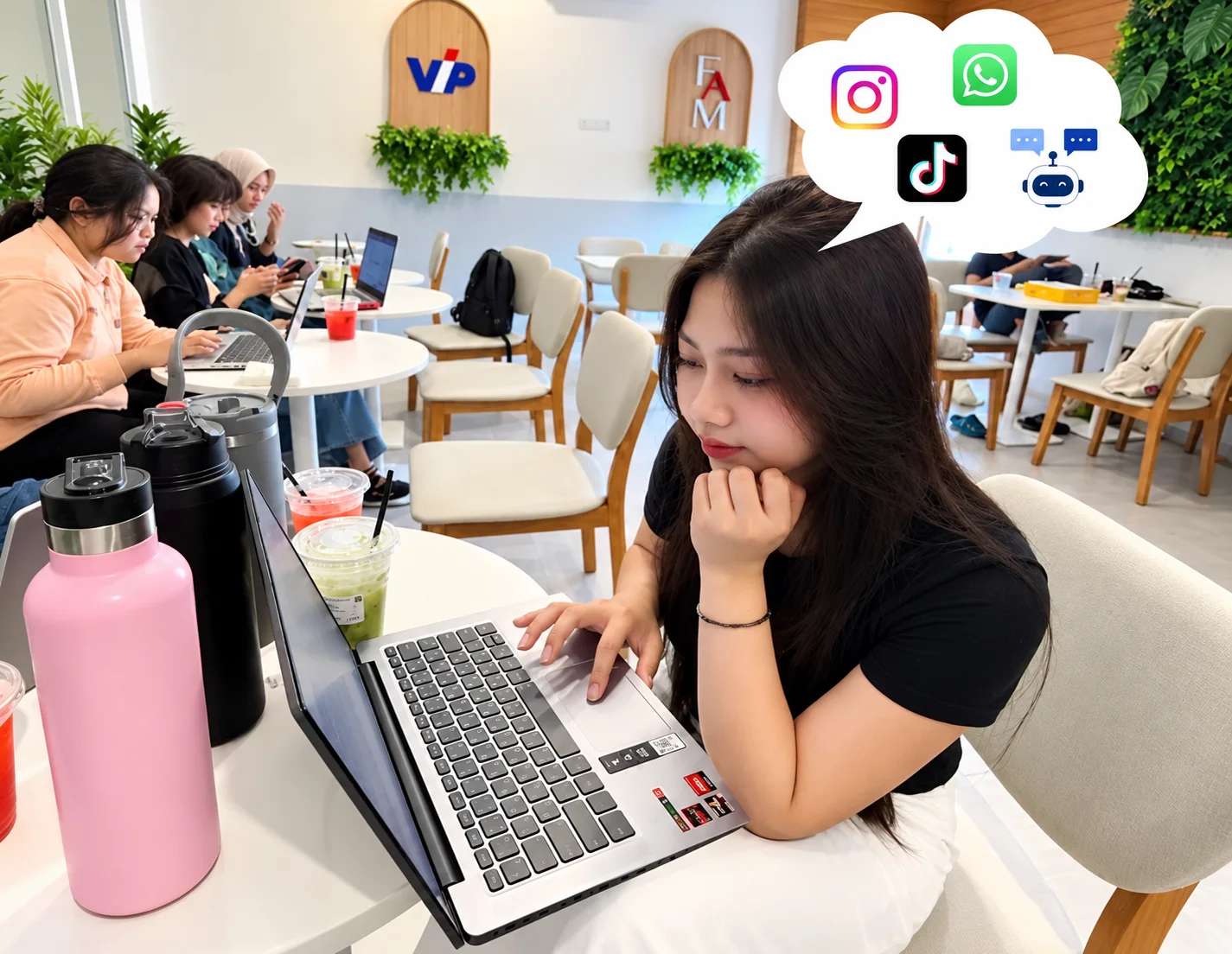
Have you ever sat in front of a laptop with the intention of doing college assignments, only to find yourself still scrolling through videos on TikTok two hours later?
Initially, we only want to open our phones for a moment to check notifications or see if there are any incoming messages. However, after that, we end up opening TikTok, finding interesting videos, and then continuing to scroll the screen until we do not realize how much time has passed. As a result, college assignments are forgotten and eventually have to be done in a rush.
The phenomenon of "intending to study, but ending up on the FYP" seems familiar in the lives of students today. We start out wanting to be productive, but end up spending time watching various content without a clear purpose.
We need to admit that maintaining focus while studying is not easy, especially when our phones are always near us. TikTok and Instagram provide various interesting content and entertainment that can be enjoyed just by scrolling the screen (scrolling).
This is also related to how social media algorithms work. TikTok and Instagram use recommendation systems to display content deemed relevant to the user's interests.
The more often we interact with a certain type of content, the greater the likelihood that similar content will reappear on the recommendation page. This condition can make us keep watching without realizing how much time has been spent.
Actually, social media does not always bring negative impacts. Many accounts share study tips, scholarship information, and various knowledge that is useful for students. Social media can also be used to keep up with trending issues.
In addition, social media opens up opportunities to earn income, for example by becoming a content creator, opening an online shop, or participating in an affiliateprogram.
The problem arises when we start having difficulty controlling our social media usage time and end up spending too much time scrolling.
This condition often happens because we feel we will only open social media for a moment. We think we will return to doing assignments after watching one or two videos. However, without realizing it, that activity lasts much longer than planned.
As a result, assignments that should have been completed earlier are only done when the deadline is approaching.
Multitasking: Looking Busy, but Not Necessarily Productive
Besides the dependency on instant answers and the habit of scrolling, another challenge faced by students is dividing their attention while studying.
Have you ever done assignments while replying to WhatsApp messages, opening Instagram, scrolling TikTok, and then occasionally asking AI about the assignment you are working on?
It feels like doing many things at once. We might feel productive because we keep switching from one application to another.
In reality, this habit can actually split our focus. For example, when reading an academic journal, we need to understand the content gradually. If our attention is constantly interrupted by notifications, we can lose the flow of the discussion and eventually have to re-read the parts we previously read.
The use of AI can also be part of the problem if we only read the answers at a glance without trying to understand the explanation provided.
Added to the habit of opening social media during the study process, we can find it increasingly difficult to give full attention to the task at hand.
As a result, even though we look busy using various applications, it does not necessarily mean we truly understand the material or complete the work optimally.
Taking Back Control of How We Learn
So, should we stop using AI and delete social media so we can study well?
Certainly not. Instead, we need to learn to utilize technology according to our needs.
In line with the ideas in the book The Amazing Generation by Jonathan Haidt and Catherine Price (2025), it is important for the younger generation to maintain space for real-world experiences amidst the rapid development of technology.
There are several things we can start doing to build healthier digital habits.
First, create digital balance.
We do not have to avoid technology entirely, but we need to balance digital activities with daily life.
Students can utilize technology for learning and finding information, while also setting aside time to rest, exercise, and engage in various other activities away from the screen.
Second, try a digital detox.
Occasionally, we can take a break from social media, for example when studying, eating with friends, or enjoying free time.
This break does not mean rejecting technological progress, but rather giving ourselves the opportunity to enjoy activities without having to be constantly connected to a screen.
Third, build real-life connections.
Social relationships are not only built through short messages or social media.
Joining campus organizations, discussing in person, and spending time with friends can help students build more meaningful communication while understanding other people's perspectives.
Fourth, apply wise use of AI.
Not everything has to be completed using AI assistance. We need to utilize it according to our needs, for example to understand difficult material or find additional explanations, not for every simple question that we could actually think through ourselves.
Furthermore, the use of AI also requires resources, such as electricity and water, to support data center operations.
Therefore, using AI wisely also means avoiding unnecessary use. By doing so, we not only train our independence in thinking but also become more concerned about the impact of technology usage on the environment.
Fifth, prioritize real-world experiences.
Trying new hobbies, participating in campus activities, or exploring the surrounding environment are also important parts of the self-development process.
Real-world experiences provide us with the opportunity to learn new things, get to know ourselves, and build relationships with others directly.
That way, we can enjoy every process more without having to always be connected to the digital world.
As an Untag Surabaya Communication student, I see the increasingly rapid development of technology as a challenge in itself, especially in maintaining focus, processing information, and developing critical thinking skills.
Technology can indeed help the learning process. However, we also need to understand how to use it so we do not lose the ability to think independently.
Ultimately, technology and real life are not two things that must be pitted against each other. Both can run side by side as long as we are able to maintain a balance.
The most important thing is not how often we use technology, but how we utilize it without losing the opportunity to learn, interact, and enjoy life outside the screen.
References
Haidt, J., & Price, C. (2025). The Amazing Generation: Your Guide to Fun and Freedom in a Screen-Filled World. Illustration by Cynthia Yuan Cheng. Rocky Pond Books.
UNESCO. (2023). Guidance for Generative AI in Education and Research. UNESCO.
TikTok. (n.d.). How TikTok Recommends Content. TikTok Help Center.







Comments 0
Write a Comment Share your response