

JurnalPost.com - The rapid flow of information via social media makes it increasingly easy for the public to follow various events, ranging from government policies, economic issues, and social conflicts to injustice, discrimination, and natural disasters.
Such information has become a part of daily life. However, have we ever asked ourselves what happens if the news we consume every day actually affects our psychological state, leaving us feeling anxious, disappointed, or worried about the future?
Feelings of disappointment or worry when witnessing various social issues do not always indicate that a person is unable to manage their emotions. In certain situations, these feelings can arise as a response to social conditions perceived as difficult, uncertain, or unjust.
Therefore, public mental health needs to be understood not only based on an individual's ability to cope with pressure but also by considering the social and cultural environment in which that individual lives.
When News and Social Situations Become Sources of Pressure
When reading the news, people often encounter conflicting comments and public opinions. If this continues, the habit can make it difficult for individuals to disengage from information that triggers anxiety.
This phenomenon is known as doomscrolling, which is the habit of repeatedly consuming negative news or content, especially through digital media.
Additionally, there is the phenomenon of information overload, a condition where a person receives an excessive amount of information, making it difficult to process it optimally.
Research by Oktaviani and Zatrahadi (2026) discusses the relationship between doomscrolling and information overload regarding the mental health of Generation Z. The habit of repeatedly consuming negative content via social media can trigger anxiety, stress, and emotional exhaustion. Meanwhile, exposure to excessive information can increase an individual's cognitive load.
Nevertheless, everyone's experience may differ, depending on their self-regulation abilities and the coping strategies used to face pressure.
Sources of pressure on mental health do not only come from the news we read. Some people experience direct impacts from policies, economic conditions, or unfair treatment in their environments.
Therefore, suggesting that people simply reduce their news consumption is not enough to understand the full scope of the psychological pressure they experience.
The impact of news and social issues is not the same for every individual. Cultural background, economic conditions, life experiences, and social support shape how a person understands and faces a situation.
Thus, mental health needs to be understood through a broader perspective, including the social and cultural conditions that underlie the experiences of each community group.
One Nation, but Not Everyone Has the Same Experience
Indonesia is a nation with a society characterized by diverse cultures, religions, languages, economic conditions, and social experiences.
This diversity means that each individual or group may have different experiences when facing socio-political dynamics. Policies or events considered normal by some segments of society may not necessarily have the same impact on others.
Virdiyanti (2025) researched mental health within the context of collectivist cultures in indigenous communities in Java, Bali, and Sumatra.
The results of the study show that collectivist values can provide social support while strengthening an individual's psychological resilience. However, the pressure to conform to group norms and expectations also has the potential to cause stress and feelings of alienation.
These findings show that mental health experiences are closely related to cultural values and social relationships within an individual's environment.
Furthermore, cultural differences can influence how a person communicates their feelings and needs.
Research by Bangun et al. (2025) discusses the culture of ewuh pakewuh among the Javanese, which is a sense of reluctance in social interactions that can affect an individual's openness when expressing their needs or feelings.
This condition illustrates that cultural norms can influence how a person expresses emotions and faces psychological pressure.
Therefore, understanding mental health requires considering the diversity of socio-cultural contexts and the life experiences of each individual.
Understanding Mental Health Through Bronfenbrenner's Ecological Theory
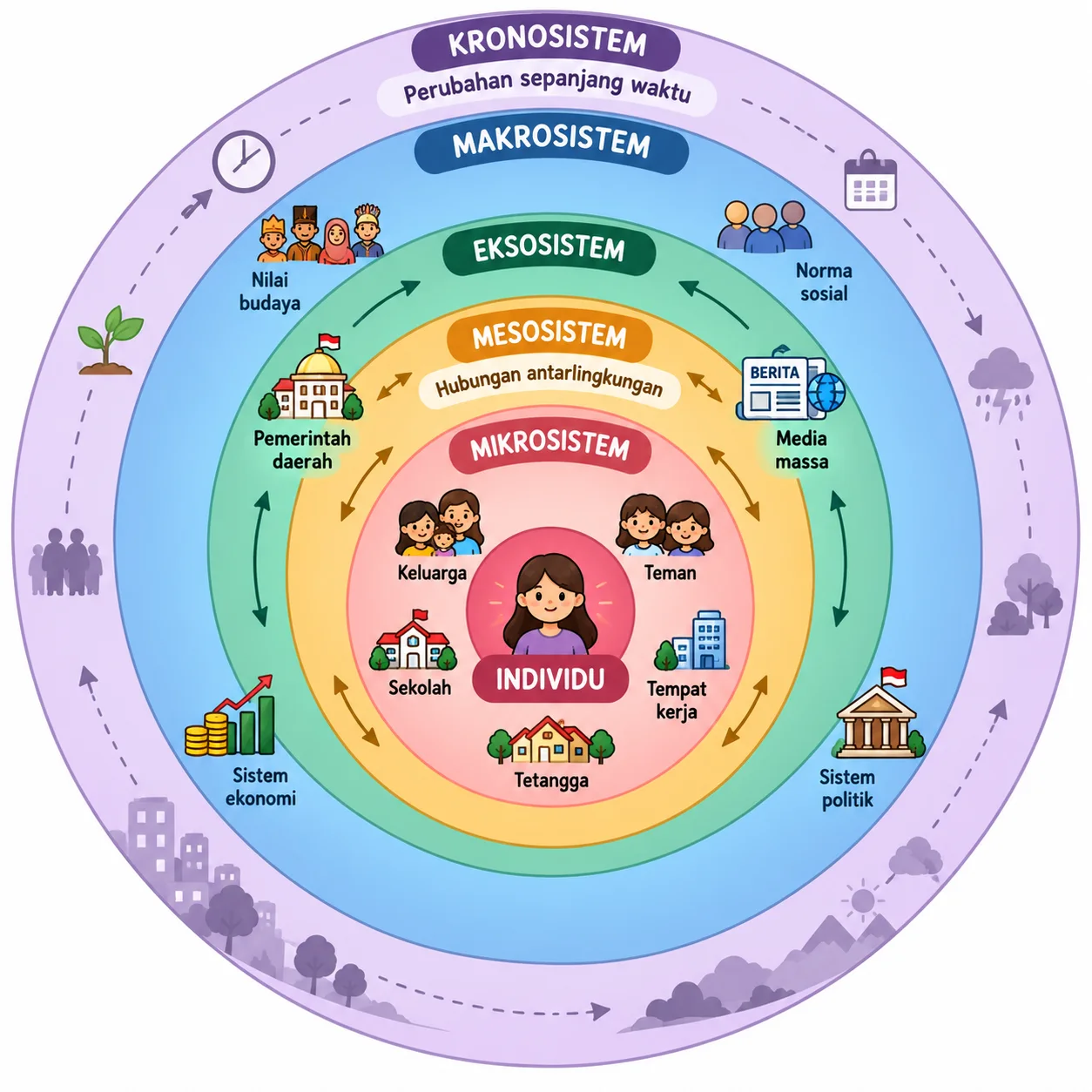
Bronfenbrenner's ecological theory explains that individual development is influenced by interactions with various environments, ranging from the closest relationships to broader social and cultural systems (Bronfenbrenner, 1979, 1994).
This perspective helps explain that a person's psychological experience is not only shaped by their way of thinking or ability to manage emotions but is also influenced by social relationships, environmental conditions, policies, and cultural values.
The influence of the environment on an individual's development and experience can be understood through the following five systems.
1. Microsystem
The microsystem is the immediate environment where an individual interacts directly, such as family, peers, school, and the workplace.
The relationships and interactions that take place within these environments can influence a person's daily experiences and psychological state.
2. Mesosystem
The mesosystem describes the relationships between an individual's various immediate environments, for example, the relationship between family and the workplace.
For instance, pressure experienced by a person in the workplace can be brought home, thereby affecting their relationships with family members and their psychological state.
3. Exosystem
The exosystem includes environments or social structures that do not always involve the individual directly but can still influence their life.
Examples include institutional policies, the working conditions of family members, and mass media coverage.
An individual may not be directly involved in the government's decision-making process. However, the policies established can affect economic conditions, access to services, and the sense of security in daily life.
4. Macrosystem
The macrosystem includes cultural values, social norms, ideologies, and broader social and economic structures.
In Indonesia's diverse society, cultural values can influence how individuals understand pressure, express emotions, and seek psychological support.
Therefore, mental health experiences need to be understood by considering the cultural background and social structures that shape an individual's life.
5. Chronosystem
The chronosystem relates to the dimension of time, including changes that occur in an individual's life or social environment throughout their life journey.
Socio-political changes, economic crises, or major events occurring during a certain period can influence how an individual views the future and adapts to circumstances.
The impact of these changes can differ for each person, depending on the timing of the event, previous experiences, and available support.
These five systems show that mental health experiences are formed within a context of interconnected environments.
Bronfenbrenner's ecological perspective can help in understanding the diversity of mental health experiences among the public amidst Indonesia's socio-political dynamics.
Thus, efforts to maintain mental health should not focus solely on an individual's ability to manage emotions but also need to pay attention to the quality of social relationships, environmental support, socio-economic conditions, and the cultural values that influence them.
Research by Omega (2023) also discusses the application of Bronfenbrenner's Process-Person-Context-Time (PPCT) model in the context of disasters.
The model emphasizes the importance of understanding individual experiences by considering personal characteristics, interaction processes, environmental contexts, and changes over time.
Although that research was in the context of disasters, the perspective used can help broaden the understanding that mental health needs to be viewed through the reciprocal relationship between an individual and their environment.
Staying Concerned Without Neglecting Mental Health
Following news developments and paying attention to the state of the country is a form of concern for our shared life.
The public has the right to know about policies that affect their lives, question injustice, and voice criticism regarding various social issues.
However, such concern must also be accompanied by an awareness of one's own limits in receiving and processing information.
One step that can be taken is to set specific times to follow the news, verify information through trusted sources, and take a break when starting to experience emotional exhaustion.
Interacting with trusted people or engaging in social activities can also help individuals gain support and reduce feelings of isolation when facing various problems.
On the other hand, mental health is not only influenced by an individual's ability to manage pressure.
Social support, environmental safety, protection against discrimination, and policies that favor public welfare also play an important role.
Therefore, the effort to maintain mental health cannot be entirely burdened on the individual. A social environment that is fair, safe, and supportive of the public's psychological well-being is also required.
Conclusion
Indonesia is a nation with a society that has diverse cultural backgrounds, social conditions, and life experiences.
Therefore, the impact of socio-political dynamics on mental health cannot be understood through a single perspective.
Exposure to negative news, discrimination, socio-economic conditions, cultural norms, and environmental support are various aspects that need to be considered in understanding the public's psychological experiences.
The multicultural perspective and Bronfenbrenner's ecological theory help explain that mental health is formed through the interaction between an individual and their socio-cultural environment.
By understanding this diversity of experiences, it is hoped that the public can build an awareness that maintaining mental health is not only related to personal ability in facing pressure but also requires social support and a more inclusive environment.
Author Profile
Ni Nyoman Yulia Niti Darma is a Master of Psychology student at Soegijapranata Catholic University. Through a multicultural psychology perspective, the author highlights the importance of understanding mental health by considering cultural backgrounds, social conditions, societal norms, and the environment in which an individual lives.








Comments 0
Write a Comment Share your response