

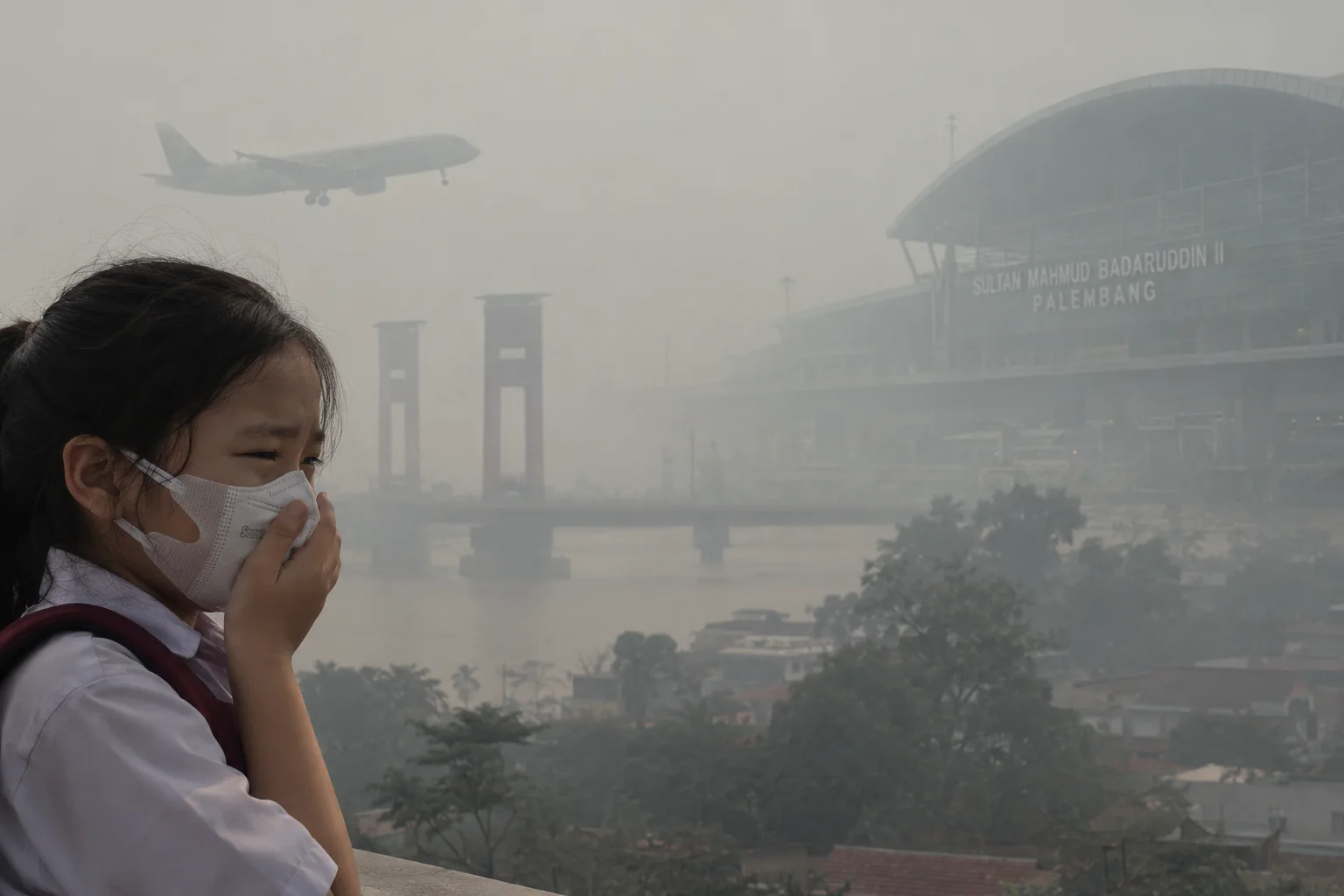
JurnalPost.com On Sunday morning, October 4, 2026, Sultan Mahmud Badaruddin II Airport in Palembang was nearly swallowed by thick smog. According to monitoring by the Ministry of Environment and Forestry's ISPUnet, the air quality index in Palembang reached 780, far exceeding the hazardous threshold. Yet, the government continues to maintain that the handling of forest and land fires (karhutla) remains under control.
That statement sounds familiar to me, having breathed Palembang's smoke in 2015. At that time, government officials also claimed that the response was equivalent to a national disaster, even though that status had not been officially declared. Eleven years later, the question remains the same: who has the authority to determine when a situation is declared an emergency?
Demands to declare the forest fires a national disaster are growing, including from students at the University of Palangka Raya. Meanwhile, local governments are maintaining the current emergency response status, citing their handling capacity and the requirements that must be met to trigger a national disaster declaration.
On the other hand, the smog has crossed international borders, affecting air quality in Singapore and Malaysia. This means the issue can no longer be viewed as a local affair. When the impacts are felt by citizens in other countries, why is the perspective on the emergency still restricted by administrative boundaries?
The gap between the smoke experienced by residents and the official claim that the situation is manageable is not merely a difference in assessment. This issue concerns public trust in the government.
Bruce Gilley (2006), in his study on state legitimacy, explains the importance of public acceptance of the authority and institutions of government. Legitimacy is not only related to the legal existence of power but also to how the public perceives and accepts the exercise of that power.
When government decisions are perceived as inconsistent with the reality experienced by the public, trust in state institutions risks weakening. In this context, the demands of students and civil society can be understood as a form of participation and a push for government policy to be more responsive to the situation.
Talcott Parsons in The Social System (1951, 1991 edition) views society as a system consisting of various interconnected roles, norms, and institutions. Changes or disturbances in one part can affect others.
Therefore, declaring a disaster status is not just an administrative terminology issue. The status relates to coordination mechanisms, decision-making, resource allocation, and the division of responsibilities between institutions.
This is where the issue of power arises. The word "emergency" is not only determined by those who breathe the smoke every day, but also by those who hold the legal authority to declare it.
From the citizens' perspective, the situation is already an emergency. The Ministry of Health recorded 277,075 cumulative cases of acute respiratory infections (ARI) across 63 regencies/cities in seven provinces affected by forest fires as of October 12, 2026. Of these, 62,400 cases involved children aged 0–5 years.
The Ministry of Transportation also recorded 1,673 domestic flights affected by the fires between August 11 and October 9, 2026. These disruptions included delays, cancellations, and diversions due to limited visibility.
Economically, the Center of Economic and Law Studies (CELIOS) estimates that the potential economic and health losses due to forest fires from January to August 2026 reached between IDR 39.29 trillion and IDR 123.1 trillion.
These figures show that the impact of forest fires does not stop at the burning forest areas. The disruption extends to public health, transportation, education, and economic activity.
However, the government still assesses that the situation can be handled through existing mechanisms. It is this distance between the residents' experience and the government's assessment that has the potential to weaken public trust.
The problem is not just happening this year. Forest fires recur almost every year, especially in areas with peatlands that are prone to burning. When the same problem keeps appearing, the public has reason to question the effectiveness of prevention and the readiness of the response.
The Constitutional Court's ruling on August 28, 2026, actually provided clarity regarding the declaration of national disaster status. Through Decision Number 261/PUU-XXIII/2025, the Court stated that the status must be based on meeting at least three of five indicators, with the number of victims being the primary mandatory indicator.
The five indicators include the number of victims, property losses, damage to infrastructure and facilities, the extent of the affected area, and the resulting socio-economic impacts.
However, these provisions also raise an important question: how are victims counted when the impact of a disaster is not always death or visible physical injury?
Have children suffering from respiratory problems, workers who have lost income, or students unable to attend school due to smoke exposure been given adequate consideration in the disaster impact assessment?
This situation can be read through the concept of cultural lag proposed by William F. Ogburn (1922). The concept explains that changes in material life and technology are not always followed by adjustments in norms and institutions at the same speed.
Today, aviation, schools, trade, and economic activities are increasingly interdependent. Environmental disturbances in one region can impact various sectors, even crossing national borders. Meanwhile, the mechanism for recognizing an emergency must still go through administrative processes and indicators that require government assessment.
The discrepancy between the scale of the impact and the speed of institutional response can create uncertainty for the public.
Recurring crises also disrupt social functions. From Parsons' functionalist perspective, society needs institutions capable of maintaining order, meeting the needs of its members, and sustaining the continuity of collective life.
When schools are disrupted, flights are grounded, and economic activities are hampered, the problem is no longer limited to putting out fires. The forest fires have affected how people go about their daily lives.
Furthermore, there is an imbalance in the decision-making process. Residents who feel the impact of the smoke the most, including children and vulnerable groups, do not have direct authority to determine the disaster status that affects their lives.
Therefore, government decisions need to be accompanied by transparent explanations that the public can understand.
In my view, the declaration of a national disaster status should be seriously considered based on legal indicators and conditions on the ground. The government certainly has reasons to be cautious, including considering handling capacity, coordination, and the administrative consequences of a change in status.
However, a national disaster status should not be understood as an admission of government failure. The status can actually be an instrument to strengthen the response when the impact of a disaster has exceeded the capacity of standard handling.
Member of Commission IV of the House of Representatives, Daniel Johan, previously also urged the government to consider a national disaster status to strengthen the mobilization of budgets, equipment, and resources for handling forest fires.
If the government deems that the status is not yet necessary, the public has the right to receive an explanation regarding which indicators have not been met and what concrete steps are being taken to protect citizens.
That explanation is important so that the statement that the government is still capable of handling the situation does not sound like a dismissal of the public's experience.
Ultimately, air quality index numbers, the number of sick people, and the magnitude of economic losses are indeed important as a basis for policy-making. However, for residents who breathe smoke every day, the emergency was felt long before those figures were announced.
If the residents' experience is not taken into account in the decision-making process, what is the meaning of a disaster status?
Perhaps the more appropriate question is no longer just when the government will declare it, but on what basis and with whom that decision is made.







Comments 0
Write a Comment Share your response