

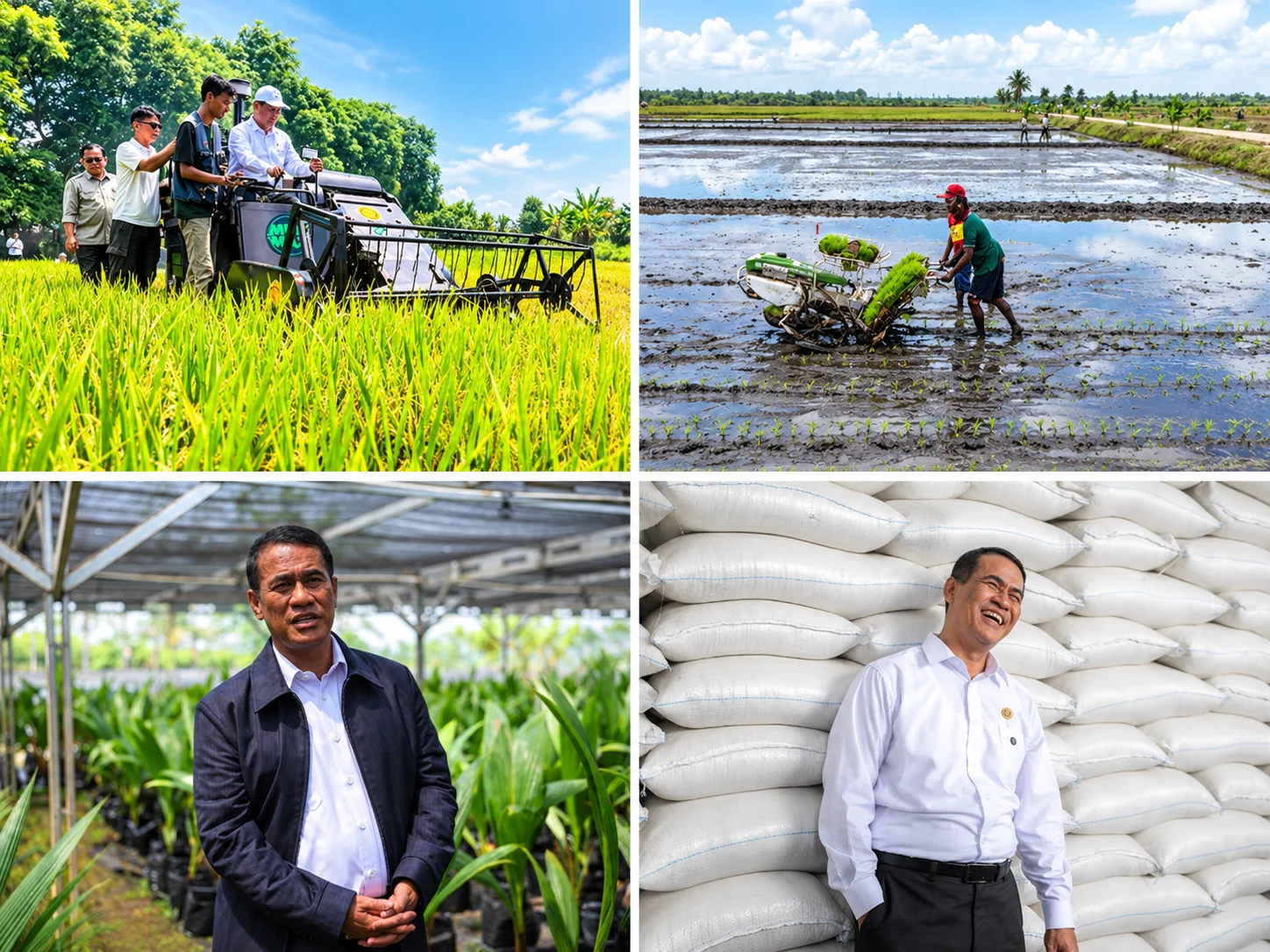
JAKARTA, JurnalPost.com - The two-year tenure of President Prabowo Subianto and Vice President Gibran Rakabuming Raka has been a period of accelerated agricultural development, particularly in strengthening domestic production, improving food governance, and increasing policy support for farmers.
One of the most prominent achievements is the acceleration of food self-sufficiency targets, supported by policies spanning from upstream to downstream.
The challenges faced have been significant. In 2023 and 2024, Indonesia imported more than 7 million tons of rice, amounting to 3.06 million tons and 4.52 million tons respectively, according to Statistics Indonesia (BPS) data.
This condition highlights the immense challenge of maintaining sufficient national rice supplies when production faces pressure from climate change.
Under President Prabowo's leadership, the government has accelerated efforts to achieve food self-sufficiency. The target, originally planned for four years, has been expedited to one year.
The President subsequently delivered a declaration of food self-sufficiency on 7 January 2026 in Karawang, West Java.
Minister of Agriculture Andi Amran Sulaiman stated that this acceleration is the result of collective work involving farmers, extension workers, local governments, ministries and agencies, the military (TNI), the police, state-owned food enterprises, and various other supporting elements.
The government is strengthening production support while encouraging the absorption of farmers' harvests and maintaining national food reserves.
"Food achievements are not born from a single policy or institution. This is the result of collective work, starting from farmers, extension workers, local governments, ministries and agencies, the TNI, the police, BULOG, to law enforcement officials. Our task is to ensure that the entire ecosystem moves in one direction: increasing production, protecting farmers, and keeping food available for the people," said Minister Amran.
One of the hallmarks of the Prabowo–Gibran administration's approach is the accelerated issuance of policies.
In two years of governance, the President has issued 16 Presidential Instructions (Inpres) and Presidential Regulations (Perpres) related to various development agendas, including the strengthening of the food and agricultural sectors.
This speed is crucial because agricultural issues require decisions that can be immediately translated into action.
Farmers require certainty regarding access to fertilizer, water availability, seeds and technology, harvest purchase prices, and support for production absorption.
In the agricultural sector, rapid policies must be followed by the simplification of procedures, inter-agency coordination, and targeted implementation. The goal is to ensure that government decisions provide real impacts for farmers and strengthen domestic production capabilities.
A number of policies have been directed toward improving subsidized fertilizer governance, accelerating irrigation rehabilitation, expanding the use of agricultural technology, strengthening the absorption of unhusked rice and rice, and maintaining food affordability for the public.
"The most important thing about a policy is its implementation. Farmers must feel the benefits directly, starting from the ease of obtaining fertilizer, water certainty, technology support, to harvests being absorbed at fair prices," said Minister Amran.
More Affordable Subsidized Fertilizer
Reforming subsidized fertilizer has become one of the steps to strengthen agricultural production.
The government issued Presidential Regulation Number 6 of 2025 and Presidential Regulation Number 113 of 2025 to improve governance and accelerate farmers' access to fertilizer.
A total of 145 regulations deemed to hinder fertilizer distribution have been cut or simplified.
This restructuring is aimed at making the distribution process more effective, with clearer roles defined between the Ministry of Agriculture, Pupuk Indonesia, local governments, retailers, and farmers.
The government also reduced the price of subsidized fertilizer by 20 percent starting 22 October 2025.
The price of urea fertilizer dropped from Rp2,250 to Rp1,800 per kilogram, while NPK fertilizer dropped from Rp2,300 to Rp1,840 per kilogram.
For 2026, the subsidized fertilizer allocation was set at 9.55 million tons, targeting more than 16 million farmers.
This policy is aimed at helping farmers obtain production inputs at more affordable prices while maintaining the continuity of farming activities.
Distribution oversight has also become part of the reform.
The government reported the rotation of 248 officials and the revocation of several distribution permits as part of the oversight measures.
Implementation must continue to be monitored to ensure that fertilizer is available at the right time, in the right quantity, of the right quality, and to the right recipients.
"Fertilizer is one of the keys to production. Therefore, fertilizer must be available at the right time, in the right quantity, of the right quality, and to the right recipients. We do not want farmers to have difficulty obtaining fertilizer when entering the planting season. Governance simplification is carried out so that services to farmers are faster and not convoluted," said Minister Amran.
Amid geopolitical turmoil and fluctuations in global fertilizer prices, the government has also emphasized the importance of maintaining fertilizer availability for domestic needs.
The interests of Indonesian farmers must be a priority before the government opens export opportunities.
"If the needs of domestic farmers are not yet secure, do not talk about exports. The first priority is Indonesian farmers. Exports can only be carried out after national stocks and needs are truly met," he asserted.
Irrigation, Technology, and Grain Prices Strengthened
Increasing production does not depend solely on fertilizer. Water availability, seed quality, mechanization, and certainty of harvest prices also determine the ability of farmers to increase productivity.
The government reported the rehabilitation of irrigation covering 280,880 hectares with a realization rate of 99.93 percent in the first phase.
To face climate risks in 2026, the Ministry of Agriculture prepared pump irrigation for land covering 2.2 million hectares and irrigation rehabilitation for approximately 1 million hectares.
The government also utilized 61 dams, which are estimated to have an irrigation service potential of approximately 400 thousand hectares.
Strengthening water infrastructure is expected to help farmers expand planting areas and increase planting frequency, especially in regions that have historically relied on rainfall.
However, physical development must be accompanied by the management and maintenance of irrigation networks so that the benefits truly reach farmers' fields.
Water availability needs to go hand-in-hand with support for production inputs and technical assistance.
"Water is an important factor in production. Irrigation must not stop at physical development. There must be management, maintenance, and water certainty reaching farmers' fields. We are directing pump irrigation and irrigation rehabilitation to ensure farmers can plant more extensively and more frequently," said Minister Amran.
The Ministry of Agriculture is also encouraging the use of superior seeds, agricultural machinery, and the development of the Modern Advanced Agricultural System (PM-AAS).
The program is aimed at increasing work efficiency and productivity, with implementation adapted to land conditions and farmers' capabilities.
Seeds with a potential yield of at least 8 tons per hectare have reportedly been distributed to farmers.
This potential is a result that can be achieved under certain conditions, so actual results remain influenced by variety, land conditions, water availability, fertilization, and cultivation techniques.
"Technology must provide real benefits to farmers. Mechanization, superior seeds, and modern agriculture must lower production costs, increase productivity, and accelerate work in the field. However, technology must be adapted to land conditions and farmers' capabilities," said Amran.
On the downstream side, the government set a grain purchase price of Rp6,500 per kilogram for harvested dry grain in accordance with applicable regulations.
This price policy is intended to maintain the value of farmers' harvests, with implementation that continues to consider grain quality, moisture content, location, and logistics costs.
"The grain purchase price must provide a sense of justice to farmers. Farmers must obtain decent profits to remain enthusiastic about planting. At the same time, implementation in the field must consider quality, moisture content, location, and logistics costs," he said.
Rice and Corn Production Increases
Strengthening production support is going hand-in-hand with increasing the production of several strategic commodities.
Based on BPS fixed figures, Indonesia's rice production in 2025 reached 34.69 million tons, an increase of 13.29 percent compared to 2024 which was 30.62 million tons.
Paddy production in 2025 was recorded at 60.21 million tons of milled dry grain with a harvested area of approximately 11.32 million hectares.
Meanwhile, rice production for the period of January–August 2026 was reported to have reached 25.29 million tons based on data used by the government.
This increase strengthens domestic production capabilities.
Nevertheless, the sustainability of self-sufficiency needs to be supported by productivity, availability of production inputs, water management, reduction of post-harvest losses, and alignment between production and national needs.
"Production is increasing because farmers are working harder and the government is strengthening support from upstream to downstream. However, self-sufficiency is not just a production figure. Self-sufficiency means sufficient production, secure stocks, prosperous farmers, and the public obtaining food at affordable prices," said Minister Amran.
For the corn commodity, the production of dry shelled corn with a moisture content of 14 percent in 2025 reached 16.16 million tons.
This figure increased by 6.74 percent compared to 2024 which was 15.14 million tons. The corn harvested area reached 2.71 million hectares, up 6.35 percent.
The increase in corn production has the potential to strengthen the supply of feed raw materials.
This is important because the availability and price of corn are related to livestock production costs and the supply of animal protein for the public.
"Corn is a strategic commodity because it is directly related to feed and animal protein prices. Production must continue to be increased, but distribution and quality must also be maintained so that the benefits are felt by farmers, livestock breeders, the feed industry, and consumers," he said.
Based on the 2026 food balance projection presented by the government, eight commodities are said to be in a state of self-sufficiency, namely rice, corn, consumption sugar, broiler chicken meat, broiler chicken eggs, shallots, large chili, and cayenne pepper.
The production of eleven strategic commodities is projected to reach 72.75 million tons, while national needs are estimated at around 68.86 million tons.
The difference of approximately 3.89 million tons is an aggregate surplus based on the food balance projection.
This figure does not mean that all commodities have a surplus individually because each commodity has different production and demand characteristics.
At the same time, soybeans, garlic, and beef still require strengthening of domestic production.
Increasing productivity, land availability, price competitiveness, and developing farming businesses are part of the follow-up work to reduce dependence on foreign supplies.
"There must be no complacency. Rice and corn must continue to be strengthened, while soybeans, garlic, and beef are follow-up work. Our target is not just momentary self-sufficiency, but sustainable food independence," asserted Amran.
BULOG Procurement Strengthens Government Rice Reserves
Increased production needs to be followed by the state's ability to absorb harvests.
In this regard, the procurement of grain and rice by Perum BULOG plays a role in strengthening the Government Rice Reserve (CBP) while supporting supply stabilization.
As of 8 October 2026, Perum BULOG reported that domestic grain and rice procurement reached 4,115,014 tons in rice equivalent.
This figure is equivalent to 102.88 percent of the government's assignment target of 4 million tons.
This achievement is higher than BULOG's procurement in 2025 of 3,191,969 tons in rice equivalent and exceeds the achievement in 2012 which was recorded at around 3.65 million tons, based on figures presented by the government.
BULOG procurement is different from national production.
Procurement reflects the amount of grain and rice absorbed by the company, whereas national production includes the entire harvest, whether absorbed by BULOG or marketed through other channels, stored, or consumed by the farmers themselves.
Strong domestic procurement can help maintain government reserves and support supply stabilization.
However, its benefits for farmers and consumers also depend on purchase prices, distribution costs, rice quality, and the effectiveness of distribution.
"BULOG procurement that has broken through more than 4 million tons shows that farmers' harvests are being absorbed. This is important to maintain prices at the farmer level while strengthening government reserves. However, the work is not finished. Absorption must continue to be monitored so that the benefits are felt by farmers and the community," said Minister Amran.
The government reported BULOG stocks of around 5.3 million tons at the beginning of June 2026 and more than 5 million tons in April.
Meanwhile, the Government Rice Reserve in September 2026 was said to be around 4.61 million tons.
Differences in figures between periods need to be viewed by paying attention to the recording date, procurement, distribution, and the definition of stock used.
Adequate reserves give the government room to respond to production disruptions, disasters, and price volatility.
Therefore, stock management needs to be accompanied by transparent recording, quality maintenance, and distribution planning according to regional needs.
"Food reserves are the strength of the state. Strong stocks give the government room to respond to price volatility, disasters, and production disruptions. Therefore, reserves must be managed carefully, transparently, and always updated through domestic procurement," he said.
The government stated that general rice imports for consumption have been stopped.
This policy needs to be distinguished from imports for special needs that have their own types, purposes, volumes, timing, and policy bases.
Open explanations regarding import policies are still needed so that the interests of farmers and national food needs can be maintained in a balanced manner.
Food Budget and Assistance to Maintain Affordability
Budget support is part of the effort to strengthen production and maintain food availability.
In the 2026 state budget draft, the government prepared around Rp164.4 trillion to support national food security.
This figure is the planned allocation, not the overall realization of expenditure.
This support includes various programs, including fertilizer subsidies, BULOG assignments, and the strengthening of reserves and food barns.
Its effectiveness needs to be viewed from the accuracy of the targets, budget realization, program results, and the benefits received by farmers and the community.
"The food budget must return to the people in the form of increased production, more prosperous farmers, stronger stocks, and more affordable prices. Every rupiah must be accounted for through measurable results," said Amran.
In addition to strengthening production, the government is running rice food assistance and the Food Supply and Price Stabilization (SPHP) program to help maintain availability and price affordability.
In 2025, rice food assistance and SPHP were targeted to reach 18.3 million beneficiaries, with a distribution target of around 1.3 million tons of SPHP rice.
This figure is the program target. In 2026, the government continued assistance and stabilization efforts through BULOG.
The impact of the program needs to be assessed through the accuracy of recipients, the amount of assistance received, the timing of distribution, market price developments, and changes in households' ability to meet food needs.
"The government must be present on two sides. Farmers must obtain decent prices, while the community, especially vulnerable groups, must get food at affordable prices. Food assistance and SPHP are important instruments to maintain that balance," said Minister Amran.
BPS recorded monthly inflation in September 2026 at 0.30 percent.
In the food group monitored, rice was said to contribute 0.03 percent to inflation, cayenne pepper 0.08 percent, red chili 0.06 percent, and broiler chicken meat 0.05 percent.
The inflation contribution figure shows the contribution of a commodity's price change to inflation, not the price level or a direct measure of household welfare.
Food stability therefore still requires oversight of production, distribution, logistics costs, market structure, and public purchasing power.
Protecting Farmers Against Climate Risks
Climate change and extreme weather remain challenges for production sustainability.
To reduce farming business risks, the Ministry of Agriculture targeted the facilitation of Rice Farming Business Insurance (AUTP) covering 100,000 hectares in 2026.
In the planned scheme, an insurance premium of Rp180,000 per hectare per planting season receives a government subsidy of 80 percent or Rp144,000.
Farmers bear the remainder of Rp36,000 per hectare.
Insurance is expected to help farmers face risks covered in the program.
Implementation needs to be supported by accurate data collection, ease of registration, damage verification, and claim payments in accordance with regulations.
This protection must also run alongside irrigation development, seed provision, water management, and agricultural assistance.
"Farmers must not be left to face climate risks alone. Agricultural insurance is a form of protection so that when a guaranteed risk occurs, farmers have the ability to return to production. However, protection must run alongside irrigation, seeds, technology, and assistance," said Minister Amran.
Exports and Downstreaming Must Provide Added Value
Increased production opens opportunities to develop markets and increase the added value of agricultural products.
In August 2026, Indonesia reportedly sent 1,000 tons of rice to Malaysia and 2,280 tons to Saudi Arabia to meet the needs of Hajj pilgrims.
The implementation of food exports needs to pay attention to the type of rice, source of supply, permits, and its impact on domestic stocks.
Exports must be carried out while prioritizing the adequacy of national needs and providing economic benefits to farmers.
The export value of agricultural products throughout 2025 was said to reach around Rp756.59 trillion, an increase of Rp166.71 trillion or 28.26 percent compared to 2024.
Meanwhile, the import value was said to have fallen by around Rp41.68 trillion or 9.66 percent.
This figure needs to be read according to the product coverage and statistical categories used.
The government also discussed urea export opportunities on the condition that domestic needs are met first.
The availability of production inputs for farmers must remain a primary consideration in trade policy.
"Downstreaming and exports must be a means of increasing added value for farmers and the national economy. However, exports must not reduce the availability of food and production inputs for the domestic community. The principle is clear: national needs are met, farmers are protected, then export markets are developed," said Minister Amran.
The development of agricultural downstreaming, B50 biodiesel, and bioethanol also opens opportunities for increased demand for agricultural products.
At the same time, this policy needs to take into account the balance of food, feed, energy needs, land use, raw material prices, and environmental impacts.
Trade Oversight and Law Enforcement
In addition to production and reserves, food trade is an important part of maintaining farmers' welfare and price affordability for consumers.
Adequate stocks do not automatically make prices affordable if there are distribution constraints, high logistics costs, supply imbalances between regions, or harmful trading practices.
Minister Amran requested that allegations of price manipulation, stock manipulation, cartels, product counterfeiting, and other violations in food trade be handled in accordance with legal provisions.
Oversight is needed to ensure that the supply chain runs healthily and that farmers are not the party most disadvantaged.
"Farmers must not be the weakest party in the food chain. If there are parties playing with prices, counterfeiting products, withholding stocks, or harming farmers and consumers, we will submit these findings to law enforcement officials to be processed in accordance with regulations," said Amran.
Throughout 2024–2026, the Minister of Agriculture reported 260 cases of alleged food mafia to law enforcement.
The report includes allegations of adulterated rice with an estimated potential consumer loss of Rp99.35 trillion per year and allegations of fake fertilizer with an estimated potential farmer loss of Rp3.2 trillion.
This figure is an estimate of potential losses reported, not a court decision or actual losses proven for all cases.
The handling of each case must still refer to evidence, the investigation process, and the principle of presumption of innocence.
"The handling of alleged violations must be firm, but still based on evidence and the law. We respect the investigation process and the principle of presumption of innocence. What we are fighting for is a healthy, transparent food trade that does not harm farmers or consumers," asserted Minister Amran.
Maintaining Sustainable Self-Sufficiency
Two years of the Prabowo–Gibran administration show a change in food policy direction through accelerated regulation, improved subsidized fertilizer governance, irrigation strengthening, increased rice and corn production, harvest absorption, and government reserve management.
The government stated that Indonesia has achieved rice self-sufficiency and stopped general rice imports for consumption.
This achievement needs to be maintained through monitoring production, consumption, stocks, distribution, and national needs with consistent and verifiable data.
Self-sufficiency is not the end of the work.
Climate change, production costs, distribution equity, import dependence on several commodities, subsidy effectiveness, farmer welfare, price affordability for consumers, and trade oversight remain challenges that must be addressed.
The Ministry of Agriculture will continue to strengthen production, technology utilization, harvest absorption, farmer protection, and food oversight.
Policy success needs to be reflected in tangible indicators, ranging from productivity and farmer income, prices at the producer and consumer levels, assistance accuracy, reserve quality, to budget usage effectiveness.
"Two years of real action is not the finish line. Our work is to ensure that self-sufficiency lasts, production continues to increase, farmers become more prosperous, and the people get enough food at affordable prices. Food is a matter of the people's stomachs, so every policy must provide real benefits and be accountable," concluded Minister Amran.
The success of food development is not only measured by the volume of production or the height of stocks, but also by the ability to maintain supply sustainably, provide fair prices for farmers, and ensure that the public can access food at reasonable prices.






Comments 0
Write a Comment Share your response