


Klaten, JurnalPost.com — Students from the Yogyakarta State University (UNY) Community Service Program (KKN) Group 31132 in Hamlet II, Paseban Village, Bayat District, Klaten Regency, have developed a village potential booklet as a medium to promote tourism and the local economy.
The booklet, which was handed over on Wednesday (9/23/2026), is one of the group's primary KKN programs. This informative product was designed to introduce the potential of Paseban Village more broadly, particularly focusing on destinations and community activities that have previously remained largely unknown to tourists.
The program stems from the village's need for promotional materials capable of highlighting alternative tourism options beyond the Tomb of Sunan Pandanaran, which has long been the primary attraction in Paseban.
A similar sentiment was previously expressed by the Deputy Head of the Paseban Village Tourism Awareness Group (Pokdarwis), Wawan Sanuri. He hopes that tourists will not only recognize the village for religious tourism but also discover the other potential the village possesses.
The head of the KKN group for Hamlet II, Paseban Village, Pertamina Emir El Akbar, stated that the booklet was developed to help residents, tourists, and the general public gain a more complete overview of Paseban's local wealth.
"Personally, my colleagues and I felt that Paseban Village still needed improved promotional materials to introduce its other potential. As we all know, this village has extraordinary tourism potential, namely the Tomb of Sunan Pandanaran. However, there is no harm in developing other potential, such as creative or natural tourism attractions, to create variety and new experiences for prospective visitors coming to Paseban Village, Bayat, Klaten," said Pertamina.
The compilation of the booklet was carried out in three main stages. The team first mapped the village's potential alongside village officials, followed by data collection in the field, and finally, verification of the gathered information.
The process involved various village elements, including the village government and Micro, Small, and Medium Enterprise (MSME) actors. The involvement of these parties was a crucial step to ensure that the information in the booklet is not only visually appealing but also accurately reflects the conditions and potential of the village.
This collaboration is also linked to the achievement of Sustainable Development Goals (SDGs), particularly Goal 17 regarding partnerships for the goals. Meanwhile, from an economic perspective, the promotion of tourism potential and local products is expected to support Goal 8 regarding decent work and economic growth.
The booklet was not only produced in print. The KKN team also prepared a digital version so that information about Paseban Village can reach a wider audience and be easily shared across various platforms.
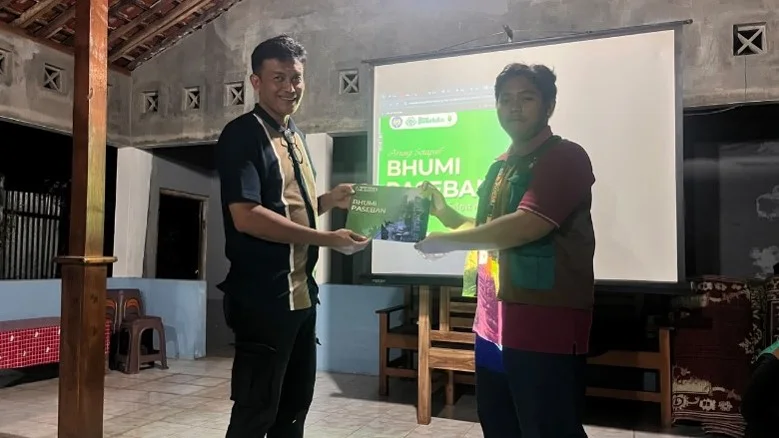
The Head of Paseban Village, Al. Eko Triraharjo, believes that the provision of the booklet will serve as an asset that the village can continue to utilize even after the students' KKN period has concluded.
"We are very grateful. The provision of this written product in the form of a booklet serves as a beneficial memento from the KKN students that will be used to promote the village's potential. This booklet also has a digital version, which is certainly a value-add because the reach of the readers will be extensive," he said.
Beyond Developing the Booklet
UNY KKN Group 31132 in Hamlet II, Paseban Village, consists of Pertamina Emir El Akbar, Rizka Isnaini Meilani, Shabrina Dwi Annisa, Regita Tunas Wijiyanti, Nurul Agista Khoirun Nisa, Saskia Ramadhani, Ghina Khoirunnisa Zulfa, Tuzia Afiany Resta, Omega Yoza Yudhistira, and Alifia Raisha Ufairah.
The students come from a number of study programs, including Tourism, History, Mathematics, and Manufacturing Engineering.
In addition to compiling the booklet, the group carried out a number of programs related to the development of tourism, history, the creative economy, infrastructure, and community empowerment.
These programs include redesigning tourism packages, compiling a guidebook for the Pokdarwis, tourism photography classes, historical film screenings, creative history classes, and the creation of historical information boards.
In the fields of skills and infrastructure, the students also held socialization on operating screen-printing machines and calculating Budget Plans (RAB). Meanwhile, one of the group's flagship programs was the activation of the village website to strengthen the digital dissemination of information.
This series of activities was designed to optimize the historical, cultural, and tourism wealth of Paseban through an educational approach and the use of information media that can continue to be used by the community.
The field supervisor, Dr. Banu Setyo Adi, explained that KKN activities are not only directed at providing benefits to the community but also at providing space for students to apply the knowledge they acquired during their studies in real-world situations.
Meanwhile, Caesar Rosyad Achmadi, S.E., M.B.A., noted that the existence of the booklet helps introduce other sides of Paseban Village that have not been widely known until now.
"The existence of this booklet is a good tool for promoting the village's potential. There is a lot of potential that many people are unaware of. Initially, I knew that Paseban Village had tourism potential, namely the Tomb of Sunan Pandanaran. However, after reading the results of this booklet, I learned about other potential beyond that. I also appreciate the hard work of the KKN students who have completed this work program. I wish them success and hope it remains useful," he said.
Through the documentation of village potential in both print and digital formats, the students hope that Paseban will have promotional materials that can be used sustainably by the village government, the Pokdarwis, MSME actors, and the community.
The program was also placed within the spirit of Impactful Science and Technology and Impactful UNY, which encourages universities to produce activities that provide a direct impact on society.
The collaboration between students, lecturers, the village government, the Pokdarwis, MSME actors, and the community is expected to continue after the KKN ends. The information assets that have been created can serve as a foundation for Paseban Village to expand its promotions, develop alternative tourism, and strengthen local economic activities.






Comments 0
Write a Comment Share your response